.png)
Seek more insights? Subscribe to our Monthly Newsletter
The UK Global Talent Visa is widely regarded as one of the most prestigious immigration routes available, and for good reason. Unlike most work visas, it does not require a job offer, a sponsoring employer, or a salary threshold. What it does require is an endorsement: a formal assessment by an approved body confirming that you are a recognised leader or emerging leader in your field.
For applicants in the digital technology sector, that endorsement comes through Tech Nation or, following Tech Nation's closure in 2023, through its successor body. Understanding global talent visa endorsement rates, what endorsers look for, and why applications are refused is essential before you invest time and money in the process.
This article draws exclusively on official government data published by the Home Office, the Migration Advisory Committee (MAC), and endorsing bodies' own published guidance. It covers the latest available figures, the criteria you must meet, the most common pitfalls, and how to maximise your chances of success.
Approval Rates by Endorsing Body (2025–26)
According to Home Office Immigration Statistics (year ending December 2024), published February 2025, a total of 5,565 Global Talent Visas were granted in the year ending December 2024 — up from 4,891 in the year ending December 2023, representing a 14% year-on-year increase.
The visa operates in two stages:
The five endorsing bodies are:
For digital technology specifically — the route most relevant to Tech Nomads clients — the official endorsement data shows:
(Source: Home Office, Immigration System Statistics, Detailed datasets — "Vis D04: Global Talent visa, endorsements by type", year ending June 2024.)
This means roughly one in three applicants for the digital technology endorsement is refused at the first stage. Understanding why is critical to building a successful application.
For context, the Exceptional Talent sub-route carries a higher evidential bar than Exceptional Promise, and official figures confirm that Promise applications make up the majority of digital technology endorsements granted — reflecting the route's design to attract both established leaders and high-potential individuals early in their careers.
What Endorsers Look For
The endorsing body for digital technology assesses applications against a published set of mandatory and optional criteria. These are set out in the official Global Talent: Endorsing Body Guidance, updated by the Home Office in 2024.
Exceptional Talent requires:
Exceptional Promise requires:
Optional criteria include peer recognition, innovation, contribution to the UK ecosystem, and commercial success, among others. The mandatory criterion in both cases is non-negotiable; no volume of optional evidence will compensate for its absence.
What Endorsement / Approval Requires
Securing a global talent endorsement demands more than a strong CV. The endorsing body is looking for evidence that meets a high and specific standard. Here is what you need to understand before you apply.
The three-layer evidential structure
Every application must include:
The endorsing body does not reward quantity. A smaller set of high-quality, directly relevant evidence consistently outperforms a bulky submission with tangential material.
The mandatory criterion in practice
For Exceptional Talent, the mandatory criterion requires that you have been a "recognised leader" — meaning your reputation and contribution are acknowledged beyond your immediate employer. Promotion to a senior title alone is insufficient. What counts is external recognition: industry awards, peer citation, published thought leadership, open-source contributions with community adoption, or verifiable impact at scale.
For Exceptional Promise, the bar is lower in terms of track record but higher in terms of specificity about future potential. The personal statement must convincingly articulate a trajectory, not merely a history.
Home Office Stage 2
Once an endorsement is obtained, the Home Office Stage 2 application is largely administrative. The applicant applies online, pays the visa fee and Immigration Health Surcharge, and provides biometric information. The Home Office's published processing target for Global Talent is three weeks for standard applications. Priority service (at additional cost) targets five working days.
Official refusal rates at Stage 2 are not published separately, but Home Office data confirms that the overwhelming majority of endorsed applicants receive a grant of leave. The Stage 2 process is not where applications typically fail.
Endorsement refusal is the primary failure point. Analysis of Home Office refusal guidance and endorsing body published criteria identifies the following as the most frequent grounds for refusal of a global talent endorsement application.
1. Failure to meet the mandatory criterion
The single most common reason for refusal. Applicants frequently submit strong evidence for the optional criteria while leaving the mandatory criteria inadequately supported. The endorsing body will not overlook a mandatory criterion gap regardless of how impressive the wider submission is.
2. Employer-centric rather than sector-wide evidence
Evidence of impact within a single organisation — promotions, internal awards, internal performance reviews — does not satisfy the requirement for external recognition. The endorsing body is assessing your standing in the sector, not your value to a particular employer.
3. Letters of recommendation that are too generic
Letters that praise the applicant's skills in general terms without addressing the specific endorsement criteria, or that come from colleagues rather than genuinely independent senior figures, carry little weight. The endorsing body explicitly flags this in its published guidance.
4. Mismatch between claimed criteria and submitted evidence
Applicants sometimes claim optional criteria for which the evidence is weak or absent, evidently hoping that quantity will compensate. This approach typically results in refusal on those criteria and, in borderline cases, tips an application from approval to rejection.
5. Personal statement that describes rather than demonstrates
A personal statement that reads as an extended LinkedIn profile — listing roles and responsibilities — without directly mapping achievements to the endorsement criteria is among the most commonly cited weaknesses in refused applications.
6. Insufficient evidence of UK nexus (for some criteria)
Certain optional criteria require evidence of contribution to, or potential contribution to, the UK's digital technology ecosystem specifically. Evidence of global impact does not automatically satisfy a UK-specific criterion.
7. Applying under the wrong sub-route
Experienced professionals occasionally apply under Exceptional Promise — which carries a lower fee and lighter evidential load — when their profile clearly merits Exceptional Talent assessment. Conversely, early-career applicants sometimes apply under Exceptional Talent and fail to meet its higher bar. Misclassification is a structural error that undermines the entire application.
How to Strengthen Your Application
The official guidance published by the endorsing body and the Home Office, combined with the statistical picture set out above, points to a number of consistent strategies for improving the prospects of a global talent endorsement application.
Audit your evidence before selecting the criteria
Begin from your evidence, not from the criteria. List your concrete, documentable achievements and then identify which criteria they genuinely support. Do not reverse this process by identifying criteria that sound relevant and then searching for evidence to fit.
Prioritise the mandatory criterion above all else
Devote the largest proportion of your personal statement and the strongest independent evidence to the mandatory criterion. Everything else is secondary.
Commission recommendation letters strategically
Identify recommenders who are both genuinely senior and independently positioned relative to you. Provide them with the specific criteria you are relying upon and ask them to address those criteria directly. A well-briefed recommender produces a far more useful letter than one who writes freely without structure.
Quantify impact wherever possible
"Led a team" is weak. "Led a team of 12 engineers that shipped a product now used by 4 million users, as reported in TechCrunch" is strong. Official guidance consistently emphasises verifiable, specific claims over general assertions.
Include third-party corroboration for every major claim
If you claim to be a recognised speaker, provide the conference programme. If you claim commercial success, provide Companies House filings or published investment announcements. If you claim open-source recognition, provide download statistics from official repositories.
Choose the correct sub-route from the outset
If you are uncertain whether your profile is more consistent with Exceptional Talent or Exceptional Promise, obtain professional advice before submitting. The application fee is non-refundable, and a refusal under the wrong sub-route weakens any subsequent application.
Do not over-submit
The official guidance advises applicants to provide focused, targeted evidence. A submission of 200 pages is not demonstrably stronger than one of 60 pages if the additional material is tangential. Endorsers are experienced assessors; volume does not signal quality.
For applicants in the digital and technology sector, the relevant endorsing body is the one operating the Digital Technology route under Home Office oversight — currently administered via UKRI following Tech Nation's closure.
Tech Nation endorsement operated until April 2023, when Tech Nation wound down its operations. The Home Office subsequently designated a successor arrangement, with UKRI overseeing the endorsement function for the digital technology route from May 2023 onwards. The criteria and the two sub-routes (Exceptional Talent and Exceptional Promise) remain substantively unchanged.
The question of which endorsing body for the Global Talent Visa to use is determined by your primary field, not by preference:
Applicants who work at the intersection of sectors, for example, a researcher in computational biology, should assess their primary professional identity and the body of evidence they can most compellingly present. It is not possible to apply to multiple endorsing bodies simultaneously.
Within the digital technology route, the choice between Exceptional Talent and Exceptional Promise should be driven by an honest assessment of your track record:
The endorsement success rate differs between the two sub-routes, though the Home Office does not publish disaggregated approval rates by sub-route in its standard statistical releases. What official guidance does confirm is that the mandatory criterion differs in its formulation between the two, and that assessors apply each criterion as written.
A refusal of a global talent endorsement application is not final. Applicants may reapply, and many do so successfully after addressing the specific grounds of refusal.
The refusal letter
The endorsing body is required to provide written reasons for refusal. This document is the essential starting point for any reapplication strategy. It will identify which criterion or criteria were not met and, in most cases, will indicate the nature of the evidential gap.
Cooling-off period
There is no mandatory waiting period before reapplying for the Global Talent Visa endorsement. However, if the refusal reflects a structural deficiency, such as a track record that genuinely does not yet meet the Exceptional Talent bar, it may be prudent to wait until additional qualifying evidence has accumulated rather than reapplying immediately with a nominally revised submission.
What changes between a first and a second application
A successful reapplication must materially address the grounds of refusal. Submitting the same application with minor amendments rarely succeeds. Common approaches include:
No limit on the number of attempts
There is no official cap on the number of Global Talent Visa endorsement applications an individual may submit. Each application is assessed on its merits at the time of submission.
Maintaining immigration status whilst reapplying
Applicants who are in the UK on another visa category should ensure they remain in compliance with that visa's conditions whilst their Global Talent application is pending or being reconsidered. An endorsement refusal does not affect the validity of an existing leave to remain. Applicants should take legal advice if their current leave is due to expire before a reapplication decision is expected.
The Global Talent Visa approval rate should be understood in the context of the broader UK immigration system. Official Home Office data provides two useful lenses: the macro picture of all routes to enter the UK, and the granular route-level comparison for work visas specifically.
The Macro Picture: All Routes to the UK
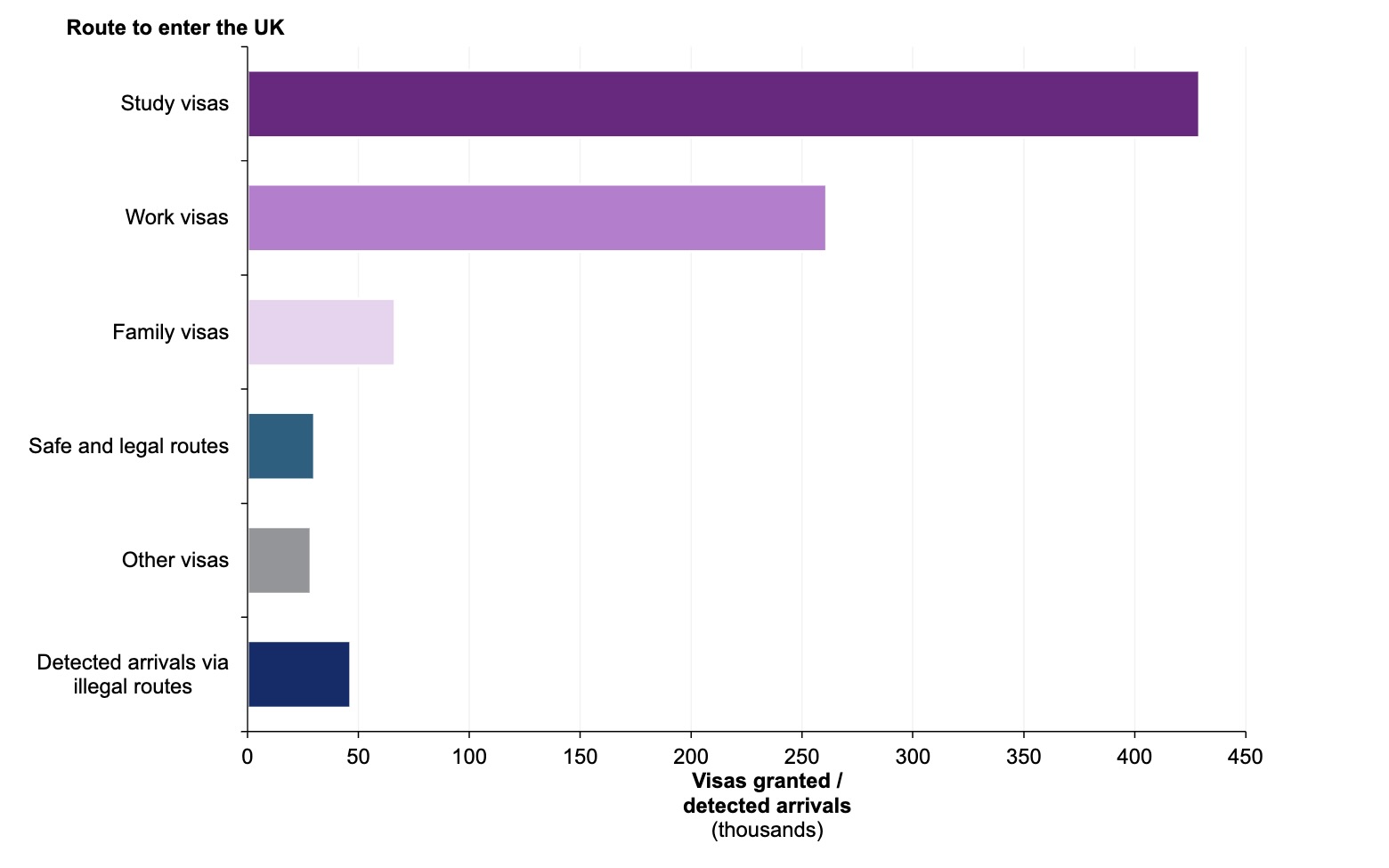
Home Office immigration statistics show that work visas — the category within which the Global Talent Visa sits, accounted for approximately 260,000 grants in the most recent reporting period, making them the second-largest legal entry route after study visas (approximately 430,000 grants). Family visas (approximately 63,000), safe and legal routes (approximately 28,000), and other visas (approximately 26,000) make up the remainder of legal arrivals.
This macro context matters for one reason: the Global Talent Visa is a small, highly selective subset within a work visa category that itself represents less than a third of total legal immigration. It is not a high-volume route. It's 5,565 grants in the year ending December 2024 represent roughly 2% of all work visa grants, which is precisely the point. The route is designed to be selective, not accessible.
Route-Level Comparison: Work Visas
For a more granular comparison, the following table draws on Home Office Immigration System Statistics data (year ending December 2024, published February 2025), specifically the Vis D01 and Vis D04 detailed datasets.
(Source: Home Office Immigration System Statistics, Vis D01 and Vis D04 detailed datasets, year ending December 2024, published February 2025.)
Several observations are relevant here:
The Global Talent Visa has a two-stage approval structure, unlike any other route: Stage 2 (post-endorsement, Home Office visa grant) sees the overwhelming majority of endorsed applicants succeed. The critical filter is Stage 1 — the endorsement itself. For the digital technology route, approximately 34% of applicants are refused endorsement. When this is factored into an end-to-end success rate, the Global Talent Visa is meaningfully more competitive than its Stage 2 grant rate alone suggests.
The Skilled Worker Visa's far higher volume does not reflect a lower bar — it reflects a different structure: Employers bear the gatekeeping burden through the sponsorship licence system. Applicants who reach the application stage have already been pre-selected by a licensed sponsor. The Global Talent Visa places the entire evidential burden on the individual, with no employer intermediary.
The High Potential Individual route is the closest comparator in terms of applicant profile — internationally mobile, high-achieving professionals, but it differs structurally. It requires no subjective expert endorsement, is tied to graduation from a Home Office-approved list of global universities, and does not lead to settlement as quickly. The Global Talent Visa (Exceptional Talent sub-route) qualifies for settlement after three years; most other work routes require five.
The Innovator Founder Visa, with its low grant volumes and relatively high refusal rate, is the most analogous route in terms of process, requiring a subjective business viability endorsement from an approved body. Its small grant numbers underscore the challenge of any endorsement-based route.
The strategic case for the Global Talent Visa remains clear: It is the only UK work route that is fully employer-independent, carries no restriction on the type or number of employers a holder may work for, and offers an accelerated path to indefinite leave to remain. Within the broader landscape of approximately 260,000 annual work visa grants, fewer than 6,000 Global Talent Visas represent a highly selective group — one whose members have been formally assessed by expert bodies as leaders or emerging leaders in their field.
Seeking assistance in your journey from the UK Visas to relocation to the UK? Tech Nomads offers personalised strategies and comprehensive support for navigating UK Visa processes.
Tech Nomads is a global mobility platform that provides services for international relocation. Established in 2018, Tech Nomads has a track record of successfully relocating talents and teams. Our expertise in adapting to regulatory changes ensures our clients’ satisfaction and success.
Tech Nomads Club
Tech Nomads Club is a curated global community for highly skilled professionals.
We host free, application-based events, including expert panel talks, start-up pitch days, members-only networking, informal meetups, and fireside conversations with industry leaders.
Membership is free but selective — open to those building across borders and seeking meaningful growth through connection, knowledge, and community.
We also produce a regular podcast that shares real stories, insights, and voices from inside the Club.
To explore your UK relocation options, you may:
Subscribe to our social media platforms to stay up-to-date on global mobility news and opportunities:
Useful Resources:





Information made available on this website in any form is for information purposes only. It is not, and should not be taken as advice. You should not rely on, or take or fail to take any action based upon this information.
© Copyright 2024, All Rights Reserved

.png)
.png)


.avif)


.png)