January 16, 2026
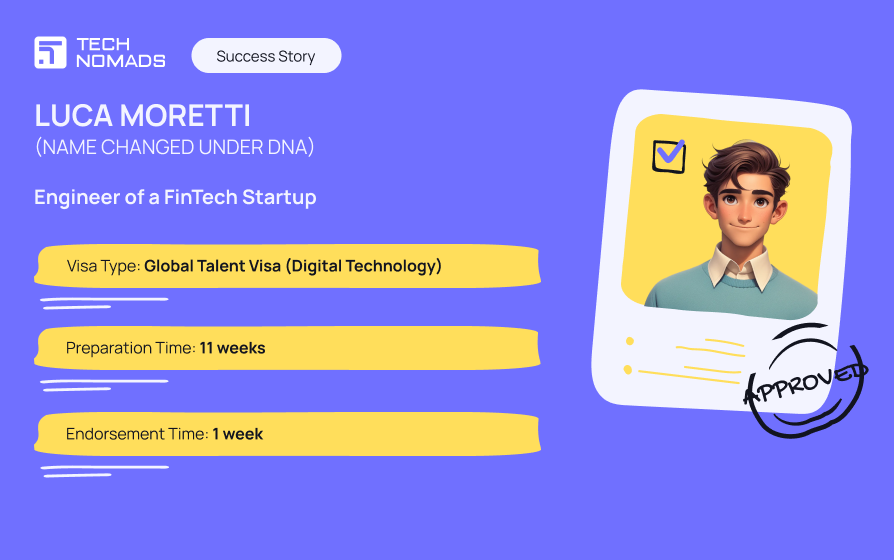
Client: Luca Moretti (name changed under NDA)
Visa Route: Global Talent Visa (Digital Technology)
Goal: Live and work in the UK
Preparation Time: 11 months
Endorsement Time: 1 week
*Disclaimer
This case study is based on a real client engagement handled by Tech Nomads. To protect client confidentiality, names, company identities, and identifying details have been anonymised or modified. Timelines, challenges, and outcomes reflect the original case.
Luca’s Global Talent journey began with disappointment. Before working with Tech Nomads, he had already submitted an endorsement application independently, and it was refused.
The rejection had a profound emotional impact. Despite years of experience in software engineering, Luca began to doubt whether his profile was truly “exceptional” enough to meet the Global Talent standard. Confidence, once taken for granted, was shaken.
One thing, however, remained clear:
He wanted to live and work in the UK — a market where engineering expertise is recognised, rewarded, and where he believed his long-term career ambitions could genuinely flourish.
Given his extensive technical background and contributions to high-growth companies, the Global Talent Visa (Digital Technology) was still the most appropriate route. It aligned with his skill set, offered flexibility, and provided a clear pathway to professional growth.
Yet the memory of a previous rejection meant he approached the process cautiously, aware that another refusal could close the door entirely.
Professional Path
Luca Moretti’s career was technically rich and diverse. The cornerstone of his case came from his role as one of the founding engineers of an African fintech startup, which he joined at a very early stage when the company had no profit and was still defining its product and architecture.
Over time, he became the engineer who laid the technical foundation of the entire platform, supporting its evolution into a multimillion-pound business and one of the most recognised fintech solutions in its regional market.
His contribution went far beyond routine development. He built, optimised, and stabilised systems that later supported large-scale growth. In many ways, his work was transformational.
However, this breadth of responsibility also created a challenge.
He had done almost everything — backend engineering, infrastructure, feature development, and system optimisation. While impressive, this made it difficult to clearly demonstrate which achievements best reflected exceptional talent under Global Talent criteria.
The key to success was focus: isolating his highest-impact engineering contributions and constructing a structured narrative from what initially appeared to be a wide, unfiltered body of work.
Preparing the application required deep, methodical work.
Luca had accumulated years of technical documentation. While much of it was valuable, not all of it supported the endorsement criteria equally. Tech Nomads guided him through filtering, refining, and organising evidence — ensuring every document served a clear strategic purpose.
This was the most demanding stage.
The initial materials were extensive and technically complex. The narrative needed to clearly demonstrate:
Building this narrative required multiple iterations, detailed discussions, and careful analytical work. Once complete, it became the strongest element of the application.
Although Luca had already left the fintech company by the time of submission, he remained proactive. When additional evidence was needed, he returned to former colleagues to request documentation, something many applicants find uncomfortable.
His willingness to do this significantly strengthened the final submission and demonstrated professional maturity and credibility.
The Role of Tech Nomads
For Luca the difference between his unsuccessful attempt and the outcome was immediately clear.
The Tech Nomads team did not simply edit documents. They analysed his full body of work, restructured evidence, and took time to understand both the technical logic behind his contributions and their commercial impact.
Because his work was deeply technical, the team held multiple clarification calls to fully capture the complexity and significance of his engineering decisions. This ensured his expertise was communicated clearly and convincingly to non-technical reviewers.
After seeing the final submission, Luca described the level of work involved as “truly staggering” — far beyond what he could have achieved alone.
At the beginning, discouragement was unavoidable. A previous refusal can undermine even highly capable professionals.
As the case took shape and each piece of evidence found its place, confidence gradually returned. Receiving endorsement in just one week became a defining moment — both professionally and personally.
His advice to others is direct:
“Place your case in the hands of professionals. They will help you position your experience in the strongest possible way.”
Looking back, Luca says he would never attempt the process alone again. If given the chance, he would have approached Tech Nomads from the very beginning.
Securing the Global Talent Visa reshaped Luca’s future almost immediately.
He successfully moved to the United Kingdom — a long-held goal that was previously unattainable without the right immigration status.
Shortly after relocating, he secured a highly paid engineering role in a market that recognises technical expertise at a global level.
Moretti now aims to continue growing as an engineer while giving back to the community — sharing lessons from his journey and supporting others navigating similar paths.




Information made available on this website in any form is for information purposes only. It is not, and should not be taken as advice. You should not rely on, or take or fail to take any action based upon this information.
© Copyright 2024, All Rights Reserved

.png)
.png)
.png)

.avif)


.png)