.png)
Seek more insights? Subscribe to our Monthly Newsletter
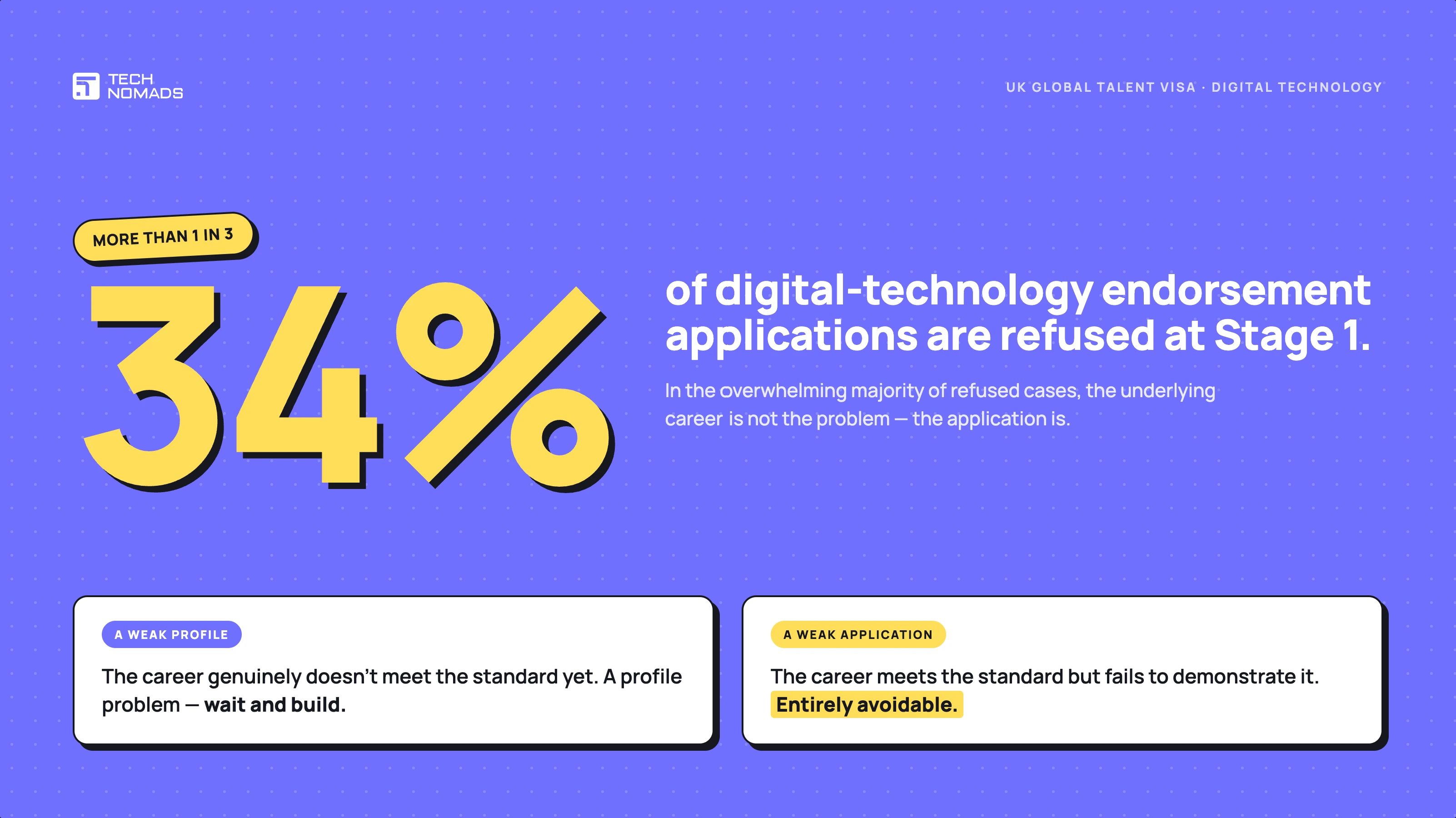
The UK Global Talent Visa endorsement refusal rate for the digital technology route sits at approximately 34% — meaning more than one in three applicants is refused at Stage 1. In the overwhelming majority of refused cases, the underlying career is not the problem. The application is.
This distinction matters enormously. A strong career that is poorly presented in an endorsement application will be refused. A strong career that is well-presented — where the evidence is specific, independently produced, and explicitly mapped to the criteria will typically be endorsed. The endorsing body does not assess the applicant's potential based on intuition; it assesses what is documented and argued in the submission it receives.
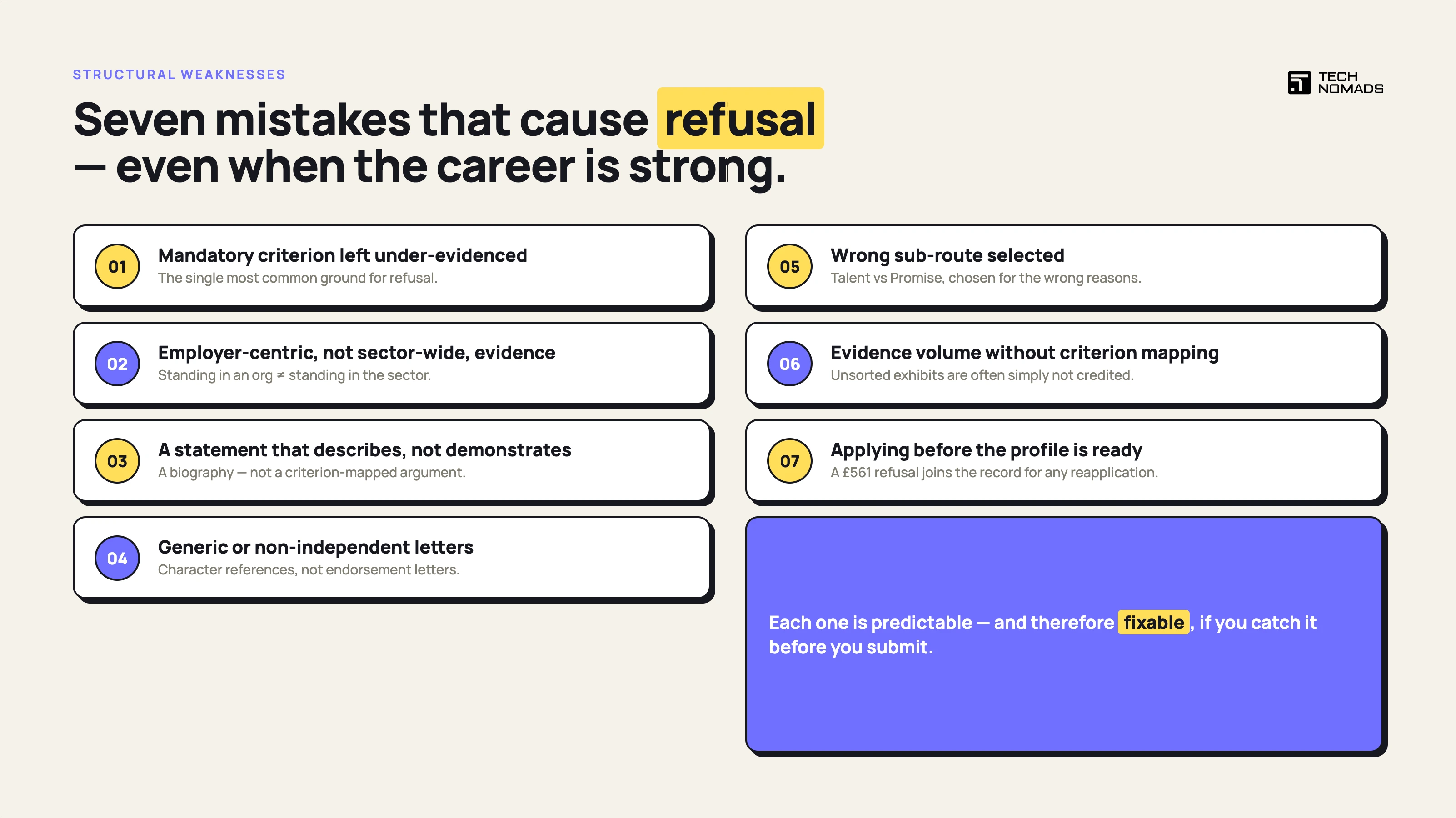
This article identifies the seven most common structural weaknesses in global talent visa applications — the mistakes that cause refusal even when the underlying professional profile is genuinely strong. It is based on the published criteria of the endorsing body, Home Office refusal guidance, and the consistent patterns that distinguish refused applications from approved ones.
Why Strong Careers Still Get Refused
A structural weakness is a flaw in the architecture of the application — not in the underlying career it is attempting to document. It is the kind of weakness that causes a qualified applicant to be refused, and an unqualified one would not have avoided.
The most important thing to understand about structural weaknesses is that they are not random. They are predictable. They appear in the same forms, in the same places, in application after application. That makes them fixable, but only if the applicant knows to look for them before submitting, not after receiving a refusal.
The Difference Between a Weak Profile and a Weak Application
A weak profile is one where the underlying career genuinely does not meet the standard — the mandatory criterion is not satisfied because the applicant has not yet accumulated the markers of external recognition that the route requires. This is a profile problem, not an application problem, and the solution is to wait and build the profile further rather than to apply now.
A weak application is one where the underlying career does meet the standard, but the application fails to demonstrate it, because the personal statement does not map achievements to criteria, or because the evidence is self-generated rather than independently produced. After all, the recommendation letters address the wrong questions, or because the wrong sub-route has been chosen. This is an application problem, and it is entirely avoidable.
How the Endorsing Body Reads Your Submission
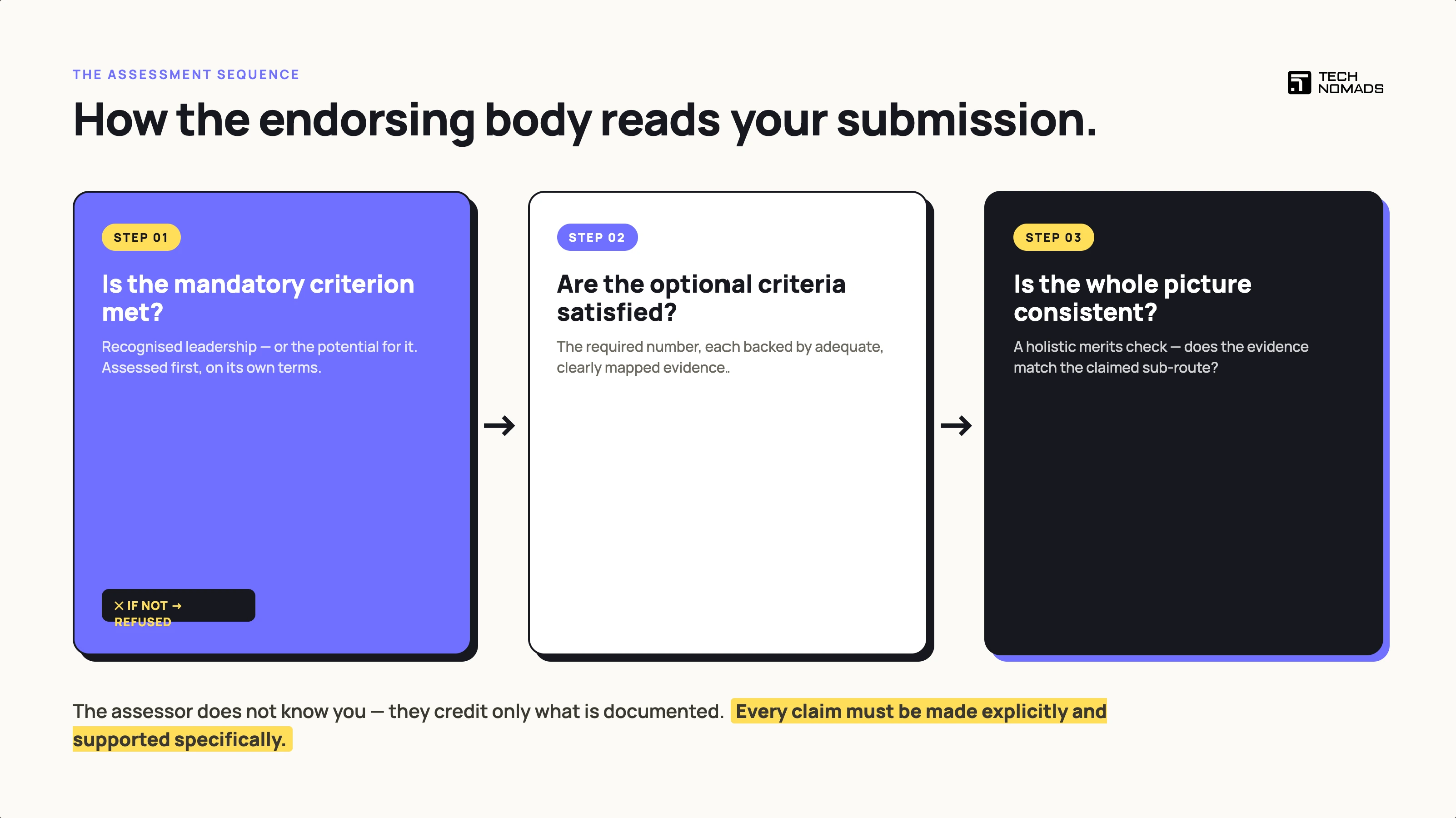
The endorsing body assesses your application in a specific sequence. First, it asks whether the mandatory criterion is met — if not, the application is refused regardless of the optional criteria evidence. Second, it asks whether the required number of optional criteria is satisfied with adequate evidence. Third, it makes a holistic assessment of whether the overall picture presented is consistent with the claimed sub-route.
The assessor does not know you. They have no context beyond what is in the submission. They will not infer significance that is not stated, assume recognition that is not documented, or credit achievements that are described but not evidenced. Every claim must be made explicitly and supported specifically.
Weakness 1: Mandatory Criterion Left Inadequately Evidenced
This is the single most common ground for refusal across both Exceptional Talent and Exceptional Promise applications. The mandatory criterion — that you have been recognised as a leader in the digital technology sector (Talent) or have the potential to become one (Promise) — is the foundation of the application. Without it, nothing else matters.
The most common form this weakness takes is an application that devotes significant space and evidence to the optional criteria while treating the mandatory criterion as self-evident. The personal statement mentions the applicant's career history, describes their achievements, and then moves on to the optional criteria — without explicitly arguing that the evidence establishes the mandatory criterion specifically.
The mandatory criterion is not established by seniority alone. A VP of Engineering title at a major technology company is not, by itself, evidence of recognised sector leadership. Recognition must extend beyond the applicant's employer — into the wider sector, through peer acknowledgment, press coverage, community engagement, or other independently verifiable markers of standing.
How to fix it: Devote the first and largest section of the personal statement to the mandatory criterion. Identify the specific, independent evidence that demonstrates external recognition, not seniority, not internal achievement, but sector-wide standing, and argue it explicitly. Every claim must be supported by a specific document referenced by exhibit number.
The global talent visa evidence must demonstrate standing in the sector, not standing within an organisation. These are not the same thing, and assessors are alert to the difference.
Employer-centric evidence includes: internal promotion records, internal awards, performance review excerpts, employer-authored testimonial letters, company-internal project descriptions, and salary data presented without sector benchmarking. All of these documents prove value to one employer. None of them has proved recognised standing in the broader digital technology sector.
This weakness is particularly common among applicants who have had strong, impactful careers at a single employer. They genuinely have achieved significant things — but those achievements are documented internally rather than externally, and the endorsing body cannot credit what it cannot independently verify.
How to fix it: Before building the application, audit your evidence for independence. For every claim in the personal statement, ask: Does the evidence for this come from a source that has no commercial relationship with me and no obligation to speak positively about my work? If the answer is no, the evidence is employer-centric and should be supplemented or replaced with independently produced documentation — press coverage, peer citations, open-source adoption metrics, conference invitation letters, or similar.
Weakness 3: Personal Statement That Describes Rather Than Demonstrates
The global talent visa personal statement is the most consequential document in the application. It is also the document most commonly written in a way that does not serve its purpose.
A personal statement that describes the applicant's career, listing roles, responsibilities, and achievements in narrative form, is not an endorsement personal statement. It is a professional biography. The endorsing body does not need a biography; it needs a structured, criterion-specific argument that maps the applicant's specific achievements to the specific criteria being claimed, with every claim supported by a referenced exhibit.
The most common form this weakness takes is a personal statement organised chronologically by employer or by time period rather than by criterion. The result is a document that may contain all the relevant information, but does not present it in the form the assessor needs to evaluate it.
What the Endorsing Body Is Actually Assessing
The assessor is reading the personal statement to answer specific questions: Does this applicant meet the mandatory criterion? Which optional criteria are they claiming? What evidence supports each criterion? Is the evidence specific, independent, and verifiable?
A personal statement that does not answer these questions clearly in the order the assessor needs them answered requires the assessor to do interpretive work that the applicant should have done. Assessors who must work to find the argument may not find it in the way the applicant intended.
How to fix it: Structure the personal statement by criterion, not by career timeline. Open with the mandatory criterion and argue it explicitly. Then address each optional criterion in turn, stating clearly which criterion is being claimed, what evidence supports it (referenced by exhibit), and why that evidence satisfies the criterion as defined. The personal statement should read as a legal brief, not a career summary.
Global talent visa recommendation letters are among the most frequently cited weaknesses in refused applications. The issues are consistent and predictable.
Generic letters praise the applicant in general terms — they are talented, experienced, hardworking, and respected without addressing the specific endorsement criteria. A letter that says "I have known [applicant] for five years and consider them one of the most skilled engineers I have worked with" does not address whether the applicant is a recognised leader in the digital technology sector. It is a character reference, not an endorsement criterion letter.
Insufficiently independent letters come from people who have a commercial relationship with the applicant — current or recent employers, clients, or close collaborators. The endorsing body is looking for independent expert opinion — recognition from people who have no obligation to speak positively about the applicant and whose assessment therefore carries credibility. A letter from a current employer, however senior the signatory, carries significantly less weight than a letter from an independent peer at another organisation who has assessed the applicant's work on its merits.
Letters that do not address the mandatory criterion leave a gap at the most critical point in the application. Every recommendation letter should address, at minimum, whether the applicant is or has the potential to be a recognised leader in the digital technology sector, the mandatory criterion in its own terms.
How to fix it: Select recommenders who are genuinely independent — senior figures in the sector who have interacted with the applicant's work from outside a commercial relationship. Brief every recommender on the specific criteria before they write, and provide them with the Home Office's published guidance on what the mandatory criteria and relevant optional criteria require. Review draft letters before they are finalised to ensure they are criterion-specific rather than generally positive.
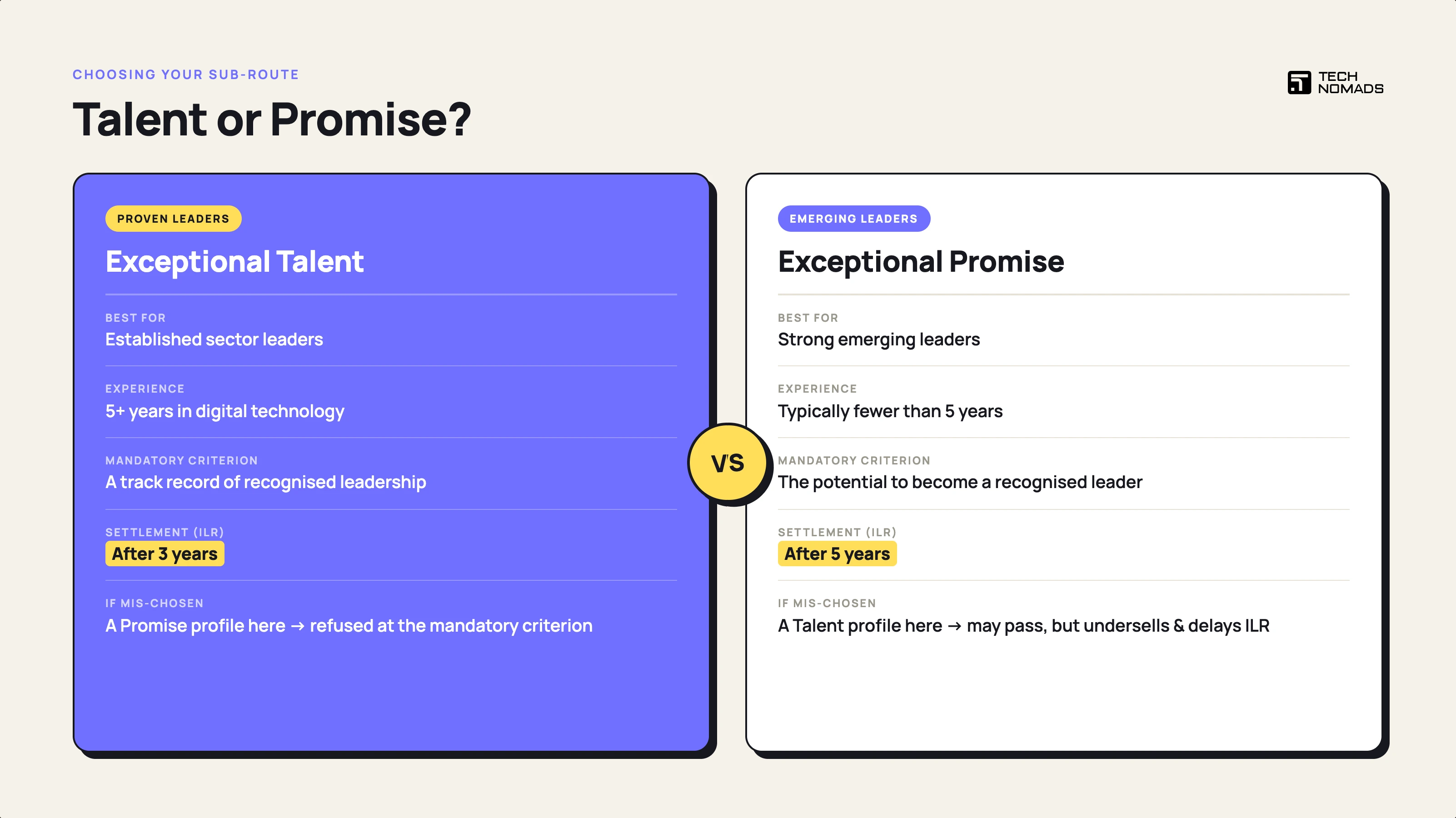
Choosing between Exceptional Talent and Exceptional Promise is one of the most consequential decisions in the application process and one that is frequently made for the wrong reasons.
Applicants sometimes choose Exceptional Talent because it sounds more prestigious, because their employer encouraged them to, or because they believe their career justifies it without having rigorously assessed the mandatory criterion against the Talent standard. The Talent mandatory criterion requires a demonstrable track record of recognised leadership, not merely a senior title, not merely significant impact within one organisation, but external recognition of sector-wide standing accumulated over at least the last five years.
Applicants sometimes choose Exceptional Promise when Talent is more appropriate — typically to reduce the evidential burden and then produce an application that undersells a profile that meets the higher standard.
The consequences of misclassification run in both directions. Applying under Talent with a Promise profile typically results in refusal at the mandatory criterion. Applying under Promise with a Talent profile may be approved, but it does not reflect the applicant's actual standing and leads to ILR after five years rather than three.
How to fix it: Assess the mandatory criterion for each sub-route honestly before choosing. If you have five or more years of experience and can point to specific, documented evidence of external recognition press coverage, peer awards, advisory roles, significant open-source adoption with community attribution — Exceptional Talent is likely the correct route. If you are earlier in your career and cannot yet point to that depth of external recognition, Exceptional Promise is the appropriate choice regardless of how impressive your internal career has been.
The endorsing body's published guidance is explicit: the quality and relevance of evidence matter more than its volume. A submission of 200 pages is not demonstrably stronger than one of 60 pages if the additional 140 pages do not speak to the criteria.
A common form this weakness takes is submitting every piece of documentation the applicant can assemble, every press mention, every conference programme, every GitHub screenshot, every performance review, without organising it by criterion or explaining its relevance. The assessor is then left to determine which document supports which criterion and why. In a high-volume assessment process, evidence that does not explain its own relevance is often simply not credited.
A related form is claiming criteria based on evidence that is technically relevant but substantively marginal — a single peer review credited as judging evidence, a regional award claimed as nationally recognised recognition, a company blog post claimed as published material in a major trade publication. Each of these may technically qualify as an exhibit for the relevant criterion. Still, the overall picture they paint is one of thin evidence that does not withstand the final merits assessment.
How to fix it: Organise every exhibit by criterion. In the personal statement, reference each exhibit by number when it is introduced in the criterion argument. Before including any document, ask: Does this materially strengthen the criterion I am claiming, or is it tangentially relevant? Include only documents that directly evidence a claimed criterion. Quality over quantity — always.
The endorsement fee is non-refundable. A refusal costs £561 and produces a refusal letter, which then becomes part of the record that any reapplication must address. Submitting before the profile is genuinely ready is the most avoidable and most costly structural weakness of all.
The most common form of premature application is submitting under Exceptional Talent before the external recognition required by the mandatory criterion has been accumulated. The applicant has a strong internal career, believes they are at the right stage to apply, and submits — only to be refused because the sector-wide recognition that the mandatory criterion requires simply is not yet in place in a documentable form.
A closely related form is submitting with a plan to strengthen the application during the process, expecting to gather additional evidence after submission. The endorsing body assesses the application as submitted. Evidence that arrives after the submission date is not considered.
How to fix it: Before submitting, complete a rigorous self-audit against the mandatory criterion and each optional criterion you intend to claim. For each criterion, identify the specific documentary evidence — not the achievements you plan to obtain, but the evidence you currently hold and assess whether it is strong enough to carry the criterion in a contested adjudication. If any mandatory criterion evidence is absent or marginal, do not submit. Wait, build the profile, and apply when the case is genuinely ready.
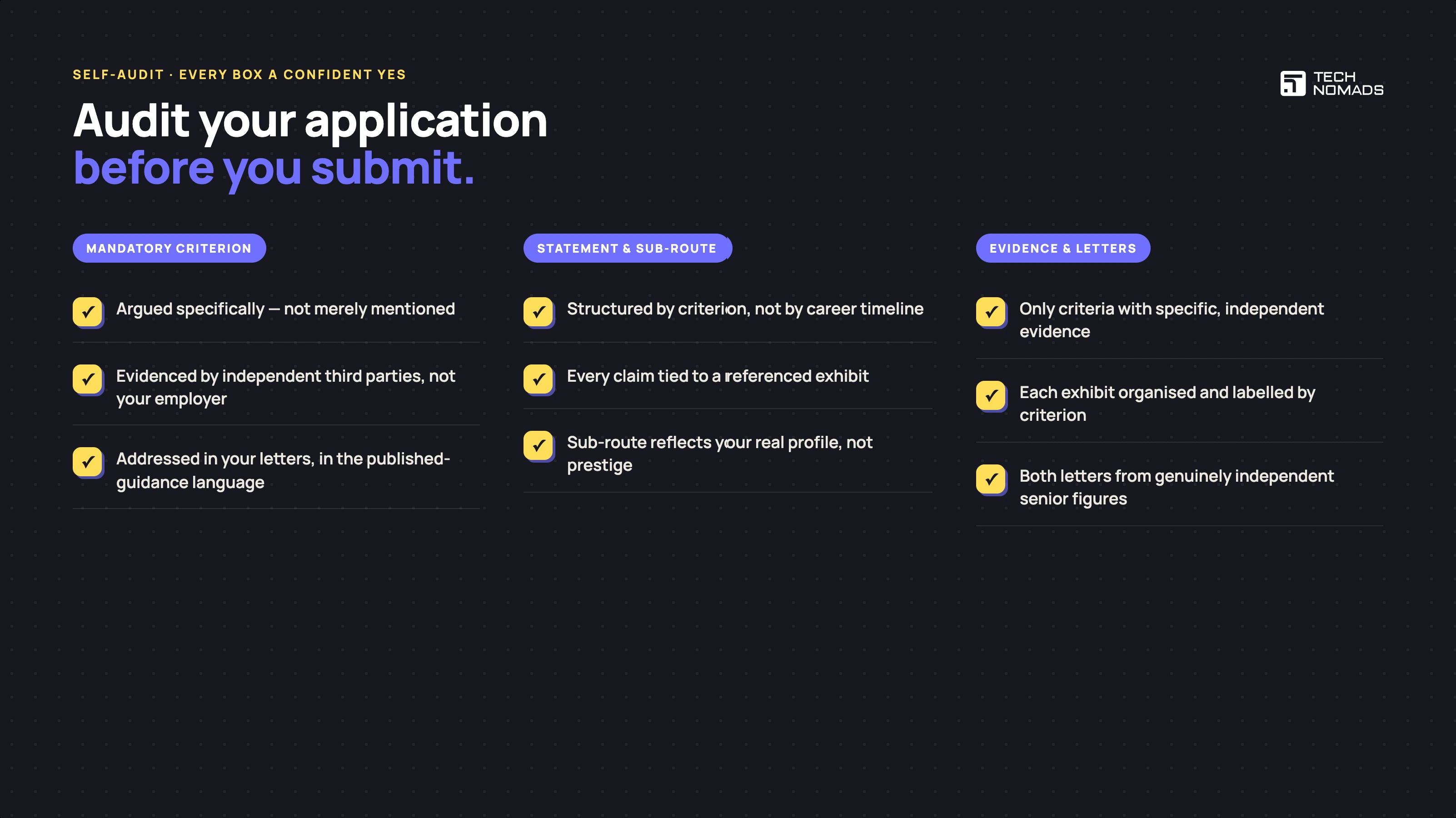
The Self-Audit Checklist
Before submitting, work through the following questions. Every mandatory item should be answerable with a confident yes.
Mandatory criterion:
Optional criteria:
Sub-route:
Personal statement:
Recommendation letters:
Evidence:
Tech Nomads is a global mobility platform that provides services for international relocation. Established in 2018, Tech Nomads has a track record of successfully relocating talents and teams. Our expertise in adapting to regulatory changes ensures our clients’ satisfaction and success.
Tech Nomads Club
Tech Nomads Club is a curated global community for highly skilled professionals.
We host free, application-based events, including expert panel talks, start-up pitch days, members-only networking, informal meetups, and fireside conversations with industry leaders.
Membership is free but selective — open to those building across borders and seeking meaningful growth through connection, knowledge, and community.
We also produce a regular podcast that shares real stories, insights, and voices from inside the Club.
Book a Consultation
Ready to find out whether the UK Global Talent Visa (Arts & Culture) is the right route for your profile?
To explore your UK relocation options, you may:
Subscribe to our social media platforms to stay up-to-date on global mobility news and opportunities:
Useful Resources:





Information made available on this website in any form is for information purposes only. It is not, and should not be taken as advice. You should not rely on, or take or fail to take any action based upon this information.
© Copyright 2024, All Rights Reserved

.png)
.png)
.png)

.avif)


.png)