O-1 Visa USA · Extraordinary Ability Route

O-1 Visa USA for Extraordinary Ability Talent

For founders, tech leaders, researchers, artists, creators and senior professionals seeking U.S. work authorisation through an evidence-led O-1 petition.
No lottery
O-1A and O-1B
U.S. attorney files
30-minute call with a Global Mobility Expert. Commercial consultation only — the U.S. petition is filed by an engaged U.S. immigration attorney.
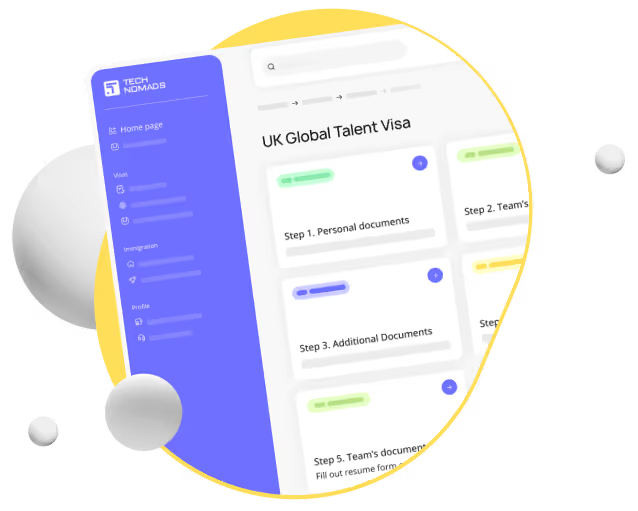
UK Global Talent Visa IT Dashboard
The Route

What is the O-1 visa?

The O-1 is a U.S. nonimmigrant work visa for individuals with extraordinary ability or achievement. It is commonly used by founders, senior tech professionals, scientists, researchers, artists, creators and athletes who need to work in the United States. Unlike some routes it is not lottery-based — but it is evidence-heavy: USCIS needs to see that your achievements meet the standard and that your planned U.S. work connects to your field.

No lottery

Not subject to the H-1B lottery cap — petitions are reviewed on merit.

Initial 3-year stay

Up to 3 years initially, with possible 1-year extensions.

Family inclusion

Spouse and children under 21 may apply for O-3 dependant visas.
Official source
USCIS
O-1 visa overview
Who It's For

Who is eligible for
the Global Talent Visa?

The UK Global Talent Visa is for people already recognised as leaders, or who show strong potential to become leaders, in academia or research, arts and culture, or digital technology. This page focuses on the digital technology route reviewed by Tech Nation.

O-1A

Business · Tech · Science · Education · Athletics

For founders, executives, product leaders, engineers, scientists, researchers, athletes and other professionals with extraordinary ability in business, science, education or athletics.

Typical candidates: CTOs, founders, AI/ML specialists, researchers, startup operators, senior executives.

O-1B

Arts · Film · Television · Creative Industries

For artists, designers, creators, performers, directors, producers and other creative professionals with recognised achievements in the arts, film or television.

Typical candidates: Designers, filmmakers, creative directors, musicians, actors, photographers, producers, content creators.

ROUTE
BEST FOR
EVIDENCE FOUCS

O-1A

Business, tech, science, education, athletics
Awards, media, judging, original contributions, authorship, high salary, critical roles.

O-1B

Arts, film, television, creative industries
Lead roles, recognition, commercial success, expert reviews, distinguished organisations, compensation.
Primary conversion

Start with a 30-minute O-1 assessment

A Global Mobility Expert reviews your background, achievements, evidence and U.S. plans, then maps your profile against the relevant O-1A or O-1B criteria — to understand whether your case is ready, conditionally ready, or not yet strong enough. The petition itself is filed by an engaged U.S. immigration attorney.

What we review

Professional background
Strongest achievements
O-1A / O-1B route
Available evidence
Evidence gaps & risks
Petitioner / agent structure
Timeline
Timeline
ACCEPT

Ready to prepare

Profile appears ready for O-1 case preparation.
CONDITIONAL

Strengthen first

Viable, but specific evidence gaps need to be addressed first.
Build & re-assess

Not yet strong enough

Profile does not currently appear strong enough for O-1 preparation.
These are Tech Nomads' internal commercial decisions about whether to take the case — not USCIS eligibility rulings or U.S. legal advice.

Tech Nation Scorecard

72 Match

Strong O-1A candidate profile

Your strongest criteria already meet the standard. A focused evidence plan closes the remaining gaps before filing.
Strong
Needs Evidence
Priority Gap
Awards & prizes
Strong
Recognition beyond your job
Needs Evidence
Published material
Strong
Judging the work of others
Needs Evidence
Original contributions
Strong
Authorship
Strong
Critical role, distinguished orgs
Strong
High salary / compensation
Priority Gap
68 Match

Promising O-1B creative profile

Lead roles and creative success are well evidenced. Recognition and compensation evidence need strengthening.
Strong
Needs Evidence
Priority Gap
Lead or starring roles
Strong
National / int’l recognition
Priority Gap
Commercial / critical success
Strong
Expert / organisation recognition
Needs Evidence
Lead role, distinguished productions
Strong
High salary / compensation
Priority Gap
Illustrative model — your real assessment is run by a Global Mobility Expert.
Book a Call
Official source
GUIDE
O-1 complete guide
O-1A Criteria

O-1A requirements for extraordinary ability

The challenge with the O-1 is not simply having achievements — it is proving them clearly. For O-1A, the case is usually built around evidence across multiple USCIS criteria categories.
Awards or prizes
Membership in selective professional associations
Published material about you or your work
Judging the work of others
Original contributions of major significance
Authorship of professional or academic content
Leading or critical role for distinguished organisations
High salary or other strong compensation evidence
USCIS typically expects evidence across at least 3 categories. Your attorney advises on which combinations are strongest for your field.
O-1B Criteria

O-1B requirements for arts & creative talent

For O-1B, the case is usually built around recognised creative work, lead or starring roles, national or international recognition, commercial or critical success, expert recognition and high compensation.
Lead or starring roles
National or international recognition
Commercial or critical success
Recognition from experts or organisations
Lead role for distinguished organisations or productions
High salary or strong compensation evidence
The Handover

What happens after your assessment call

After the call, your profile is reviewed internally by the Processing Team — your score, evidence summary and recommendation. If we proceed, an experienced U.S. immigration attorney is engaged to handle the regulated petition work.
1
Assessment Call
30-minute call with a Global Mobility Expert.
2
Processing Team Review
Internal commercial review.
3
Decision
Shared within 1 working day.
4
Attorney engaged
Attorney engaged here
Petitioner

Do you need an employer for an O-1 visa?

An O-1 petition must be filed by a U.S. petitioner — an employer, an agent, or another eligible structure, depending on your case.

U.S. employer

Most common structure. A U.S. company files the petition for the named beneficiary in a specific role.

Agent petitioner

For founders, consultants, creatives or candidates with multiple U.S. clients or projects.

Multiple employers

O-1 holders can sometimes work across engagements if the petition is structured correctly through an agent arrangement.
For founders and creatives, the petitioner structure is one of the most important strategic decisions. Your attorney advises on which structure is realistic and compliant.
Deliverables

What Tech Nomads prepares

Tech Nomads prepares the case materials needed for an O-1 petition. The petition itself is filed by an engaged U.S. immigration attorney.
Profile & evidence strategy
O-1A or O-1B route recommendation
Evidence gap analysis
Criteria mapping
Personal case roadmap
Risk areas and priority actions
Petition document preparation
CV / résumé rewritten for O-1 standards
Personal statement
Evidence documents mapped to criteria
Profile and scenario narrative
Recommendation letters drafted & structured
Referee briefing support
Founder / senior executive proof pack
Complete petition pack for attorney review
Personal Profile Boost Plan
If your profile needs strengthening before filing, we prepare a prioritised action plan — depending on your field, this may include PR opportunities, publications, judging engagements, events, reviews, exhibitions, public appearances or community contributions.
Important

Petition approval is not the same as visa issuance

An approved O-1 petition means USCIS has approved the petition — it does not automatically mean the visa has been issued. If you are applying from outside the U.S., you still need to complete the consular stage and receive the O-1 visa stamp before entering in O-1 status.

Agent petitioner

DS-160 coordination with the attorney
Supporting evidence pack
Document order & interview preparation
Dependants application support, where relevant
Certified translation coordination, where needed
Tech Nomads fees

Choose the level of support you need

Each package below sets out exactly what Tech Nomads does. Attorney fees are charged by the engaged U.S. immigration attorney and are separate from Tech Nomads service fees.
Pro — Petition Preparation
Pricing shared on your assessment call
Profile assessment & evidence strategy
O-1A / O-1B route recommendation
CV & personal statement
Recommendation letters drafted
Evidence documents organised & mapped
Complete petition pack for attorney review
Attorney filing coordination
Attorney fees billed separately.
Discuss My Case
Elite — Petition + Consular
Pricing shared on your assessment call
Everything in Pro, plus:
Consular stage coordination
DS-160 support
Interview preparation
Post-approval support
Profile Boost Plan if needed
Recommended for applicants filing from outside the U.S.
Discuss My Case
Family add-on
Pricing shared on your assessment call
O-3 dependant document guidance
Application support (spouse / child under 21)
Government fees paid separately.
Add to My Case
Final scope is confirmed after assessment and depends on case complexity, evidence strength, petitioner structure and family members. USCIS and attorney fees are separate.
Official Costs

USCIS & consular fees

These fees are paid directly to U.S. authorities (USCIS for the petition, the U.S. consulate for the visa stamp). They are not Tech Nomads or attorney service fees and should always be verified before filing.
FEE
AMOUNT
NOTES

Form I-129 (O-1 petition)

$1,015
Base USCIS filing fee

Asylum Program Fee — small employer (≤25)

$300
Added on top of I-129

Asylum Program Fee — large employer (26+)

$600
Added on top of I-129 ($0 for nonprofits)

Premium processing (optional)

$2,805
15 calendar day decision

DS-160 / visa application fee

$190
Per applicant at consular stage

Typical O-1 USCIS cost — small employer

$1,315
I-129 + Asylum Program Fee, no premium
Fees verified at the time of writing — USCIS fees change. Always check uscis.gov before filing.
The Process

O-1 process & timeline

The O-1 timeline depends on three stages: case preparation, USCIS petition processing and consular processing. Premium processing ($2,805) returns a USCIS decision within 15 calendar days but does not remove the need for a strong petition or the consular stage.
01
Step 1

Profile assessment

Route confirmation and internal review of your profile.
02
Step 2

Evidence roadmap

We map your evidence against the O-1A / O-1B criteria and identify gaps.
03
Step 3

Case strategy & document preparation

CV, personal statement, recommendation letters and evidence pack prepared.
04
Step 4

Attorney review & I-129 filing

The engaged attorney reviews, advises and files Form I-129 with USCIS.
05
Step 5

USCIS decision & consular stage

After approval, the consular stage and visa stamp complete the process.

Can your family come with you?

Your spouse and children under 21 may be eligible for O-3 dependant visas. O-3 dependants can usually live and study in the U.S. but generally do not receive work authorization. We can coordinate dependant documents as part of consular-stage support.

Does O-1 lead to a Green Card?

The O-1 is a nonimmigrant visa and does not automatically lead to a Green Card. Many O-1 holders later explore EB-1A or EB-2 NIW depending on their profile. A Green Card strategy is assessed separately.

Is O-1 better than H-1B?

The O-1 can be a strong alternative for high-achieving professionals who don't want to rely on the H-1B lottery — but it requires strong evidence of extraordinary ability, a clear U.S. work arrangement and a well-prepared petition. It is worth exploring if the evidence is strong enough.
Why Us

Why prepare your O-1 case with Tech Nomads?

Evidence-led
USCIS-criteria mapping
Attorney coordination
Consular support
Tech Nomads is a global mobility platform built for talented professionals, founders and creators. We focus on evidence-led immigration pathways and help clients turn complex achievements into structured, persuasive case materials.

Built by people who moved

Our team understands relocation because we have lived through it.

Evidence-led preparation

Structured narratives and documentation mapped to USCIS criteria.

U.S. attorney coordination

The engaged attorney reviews and files the petition; we prepare the materials.
Verify Everything

Official U.S. government sources

Verify everything against primary sources. These are the official .gov resources for the O-1 route. Tech Nomads is not affiliated with any of these agencies.
Always check official sources before any payment, document submission or filing decision. Government fees, processing times and adjudication guidance can change.
FAQ

O-1 Visa FAQs

Each answer cites USCIS as the source.

Who qualifies for an O-1 visa?

Individuals who can prove extraordinary ability or achievement in their field. This usually requires strong evidence of recognition, professional impact and a planned role or project in the U.S.

Is O-1 better than H-1B?

The O-1 avoids the H-1B lottery and is merit-based, which suits high-achieving professionals. But it is not automatically better for everyone — it requires strong evidence of extraordinary ability and a clear U.S. work arrangement.

Does an O-1 visa lead to a Green Card?

Not automatically — it is a nonimmigrant visa. Many O-1 holders later explore EB-1A or EB-2 NIW for permanent residency, depending on their profile and long-term plans.

Can I apply for an O-1 without an employer?

An O-1 needs a U.S. petitioner, but that can be an agent rather than a single employer — which is common for founders, consultants and creatives working across multiple U.S. clients or projects.

Can O-1 holders work for multiple employers?

Yes, if the petition is structured correctly through an agent arrangement covering the relevant engagements. Your attorney advises on a compliant structure.

Can my family come with me?

Your spouse and children under 21 may apply for O-3 dependant visas. They can usually live and study in the U.S. but generally cannot work.

What happens after USCIS approves the O-1 petition?

If you are outside the U.S., you complete the consular stage — DS-160, interview and the O-1 visa stamp — before entering in O-1 status. Approval of the petition is not the same as visa issuance.

How much does the O-1 cost?

USCIS fees start at $1,015 for Form I-129 plus the Asylum Program Fee ($300 small / $600 large employer); premium processing is an optional $2,805. Attorney fees and Tech Nomads service fees are separate.

Build your U.S. network with Tech Nomads Club

Relocation is not only a petition. Join a curated global community of founders, tech leaders, researchers and creators — expert talks, founder firesides, networking and practical relocation conversations.
Free to join · Application-based · Built for people creating across borders.