.png)
Seek more insights? Subscribe to our Monthly Newsletter
The EB-1A criteria are among the most scrutinised in the entire US immigration system. Every year, thousands of highly accomplished professionals file EB-1A petitions confident in their qualifications, and a significant proportion are refused, not because their careers are insufficiently impressive, but because the application did not translate those careers into the specific evidentiary framework USCIS requires.
This article works through the EB-1 visa requirements in full — the mandatory standard, the ten regulatory criteria, the evidence that satisfies each, the profiles that most commonly fail, and a practical self-assessment framework you can apply to your own case right now. All information is drawn from official USCIS published guidance, the USCIS Policy Manual, and the regulations at 8 C.F.R. § 204.5(h).
The EB-1A extraordinary ability green card is available to individuals in the sciences, arts, education, business, or athletics who have demonstrated extraordinary ability through sustained national or international acclaim. USCIS defines extraordinary ability as a level of expertise indicating that the individual is among a small percentage who have risen to the very top of their field of endeavour.
This is not a subjective self-assessment. It is a legal standard that USCIS adjudicators assess against specific regulatory criteria. Before investing in an application, every prospective petitioner should work through the following framework honestly.
Mandatory Criteria You Must Meet
To qualify for EB-1A, you must establish extraordinary ability through one of two paths.
Path 1 — Major one-time achievement: Evidence of a single award that is recognised internationally as among the top distinctions in your field — a Nobel Prize, Pulitzer Prize, Oscar, Olympic medal, or equivalent. In practice, very few EB-1A petitions succeed on this basis alone; most applicants proceed via Path 2.
Path 2 — Evidence across at least three of ten criteria: You must provide evidence satisfying at least three of the ten published regulatory criteria set out at 8 C.F.R. § 204.5(h)(3). Meeting three criteria is the threshold, but it is not sufficient on its own. USCIS then conducts a final merits determination: does the totality of the evidence establish sustained national or international acclaim, and that you are among the small percentage at the very top of the field? A petition that barely clears three criteria on thin evidence will not survive this second step.
Discretionary Criteria That Strengthen Your Case
Beyond the three-criterion threshold, the following factors consistently strengthen the final merits determination:
Evidence of recognition that is recent — within the last three to five years rather than historical. USCIS assesses sustained acclaim, not peak acclaim followed by a long plateau. Evidence of recognition that is national or international in scope, not merely local or regional. Evidence from multiple independent sources the more diverse the recognition, the more compelling the picture of sector-wide standing. Expert opinion letters from genuinely independent, credible figures in the field who can attest to the petitioner's standing and the significance of their contributions, addressing the legal standard specifically.
Self-Assessment Checklist
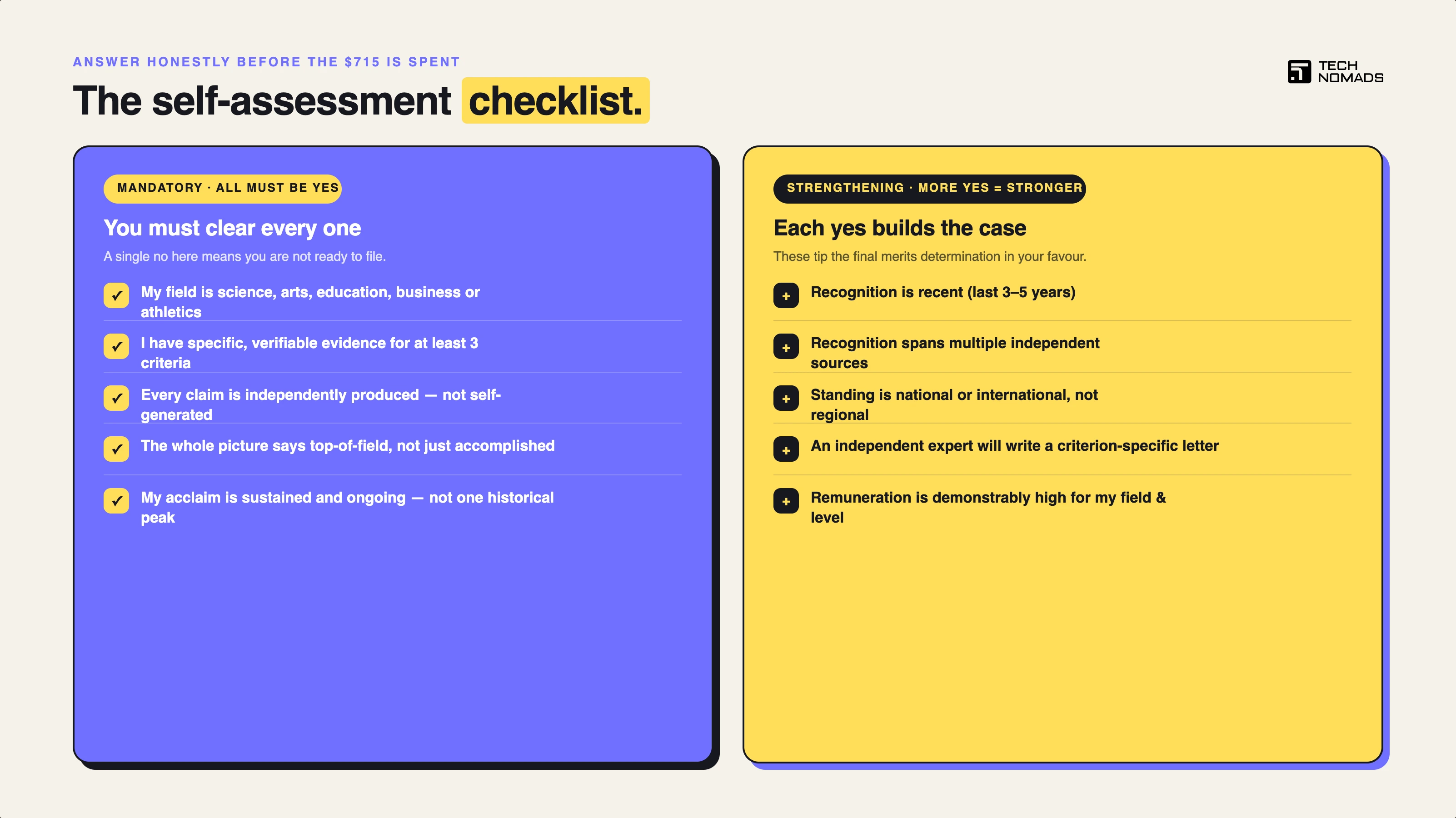
Work through the following before deciding whether to file. Every mandatory item should be answerable with a confident yes before the petition is submitted.
Mandatory — all must be YES:
Strengthening factors — the more YES answers, the stronger the case:
Mandatory Criteria Explained
The USCIS EB-1A criteria are set out in full at 8 C.F.R. § 204.5(h)(3) and elaborated in USCIS Policy Manual Volume 6, Part F. The following explains what each criterion requires and what evidence most effectively satisfies it.
Criterion 1 — Prizes or Awards Receipt of lesser nationally or internationally recognised prizes or awards for excellence in the field of endeavour. The award must be competitive — the applicant was selected on the basis of excellence and must be nationally or internationally recognised, not simply a local or institutional honour. Evidence should include the award certificate, documentation of the selection process, and evidence of the award's standing in the field (press coverage, the organisation's profile, comparable recipients).
Criterion 2 — Membership in Selective Associations Membership in associations in the field that require outstanding achievements of their members, as judged by recognised national or international experts. The association must have a genuinely selective, achievement-based membership process. Evidence should include the membership certificate, the association's published membership criteria, and evidence of the association's standing.
Criterion 3 — Published Material Published material in professional or major trade publications or major media about the person and their work in the field. The coverage must be specifically about the petitioner — not merely coverage of a project or organisation they were part of. Evidence should include the full text of the article, the publication's profile (circulation, editorial standards, industry standing), and a translation if not in English.
Criterion 4 — Judging Participation, either individually or on a panel, as a judge of the work of others in the same or an allied field. Peer review for academic journals, grant panel membership, hackathon judging, editorial board participation, and competition judging are among the most common forms of qualifying evidence. Evidence should demonstrate that the petitioner was specifically sought as a judge because of their recognised expertise — not simply that they responded to a general call.
Criterion 5 — Original Contributions of Major Significance: Evidence of original scientific, scholarly, artistic, athletic, or business-related contributions of major significance in the field. This is one of the most substantively demanding criteria. "Major significance" means the contribution has had a demonstrable impact on the field, not merely that it was technically novel or competent. Evidence should include independent citations of published work, documentation of the adoption of a methodology or technology the petitioner developed, or third-party expert analysis of the contribution's significance.
Criterion 6 — Scholarly Articles: Authorship of scholarly articles in the field, in professional journals, or other major media. For academics, this means peer-reviewed publications in journals of standing. For tech professionals, this extends to widely-read technical articles on authoritative platforms. Evidence should include the published articles themselves, the publication's profile, and citation data where available.
Criterion 7 — Artistic Exhibitions or Showcases: Display of the person's work in the field at artistic exhibitions or showcases. This criterion is most commonly used by visual artists, performers, and creative professionals. Evidence should include exhibition catalogues, programmes, venue profiles, and critical coverage where available.
Criterion 8 — Leading or Critical Role Evidence that the person has performed in a leading or critical role for organisations or establishments that have a distinguished reputation. Senior technical roles, founding roles, or principal contributor roles at recognised technology companies, research institutions, or other organisations of standing qualify. Evidence should include the organisation's profile (not merely its own claims about itself), documentation of the petitioner's specific role, and evidence of the organisation's distinguished reputation from independent sources.
Criterion 9 — High Salary or Remuneration: Evidence that the person has commanded and continues to command a high salary or other remuneration for services, evidenced by contracts or other reliable evidence. The salary must be demonstrated to be high relative to others in the same field and at a comparable career level. Evidence should include pay stubs or contracts confirming the salary, and authoritative salary survey data (Bureau of Labor Statistics, industry surveys, Levels.fyi for tech professionals) providing the comparative benchmark.
Criterion 10 — Commercial Success in the Performing Arts: Evidence of commercial successes in the performing arts, as shown by box office receipts, record, cassette, compact disc, or video sales, or other indicators. This criterion is specific to performing arts professionals and is not typically applicable to tech professionals, researchers, or business leaders.
(Source: 8 C.F.R. § 204.5(h)(3); USCIS Policy Manual Volume 6, Part F)
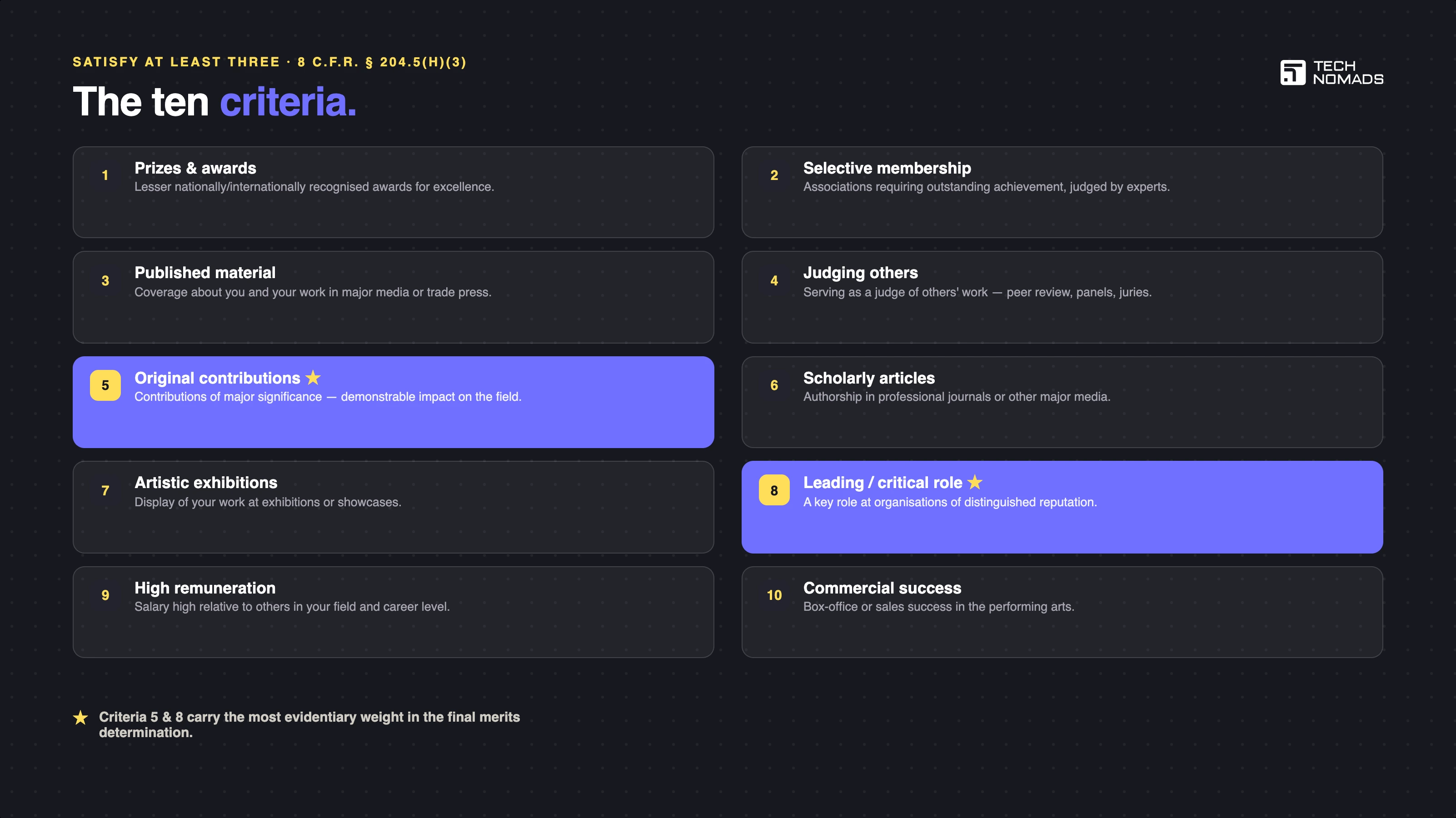
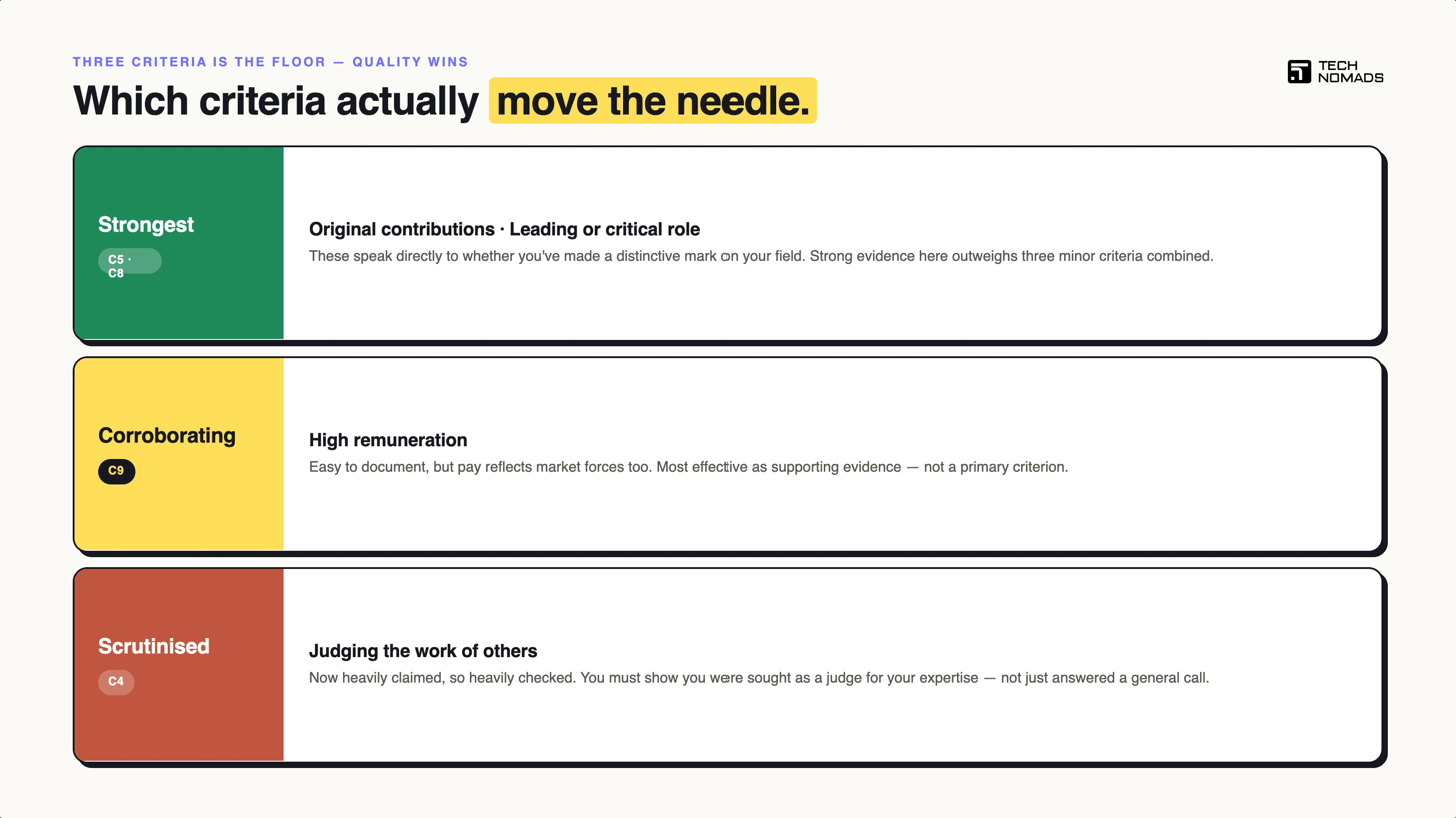
Unlike some other immigration routes, the EB-1A does not have a formal distinction between mandatory and optional criteria — all ten criteria are available to all petitioners, and the requirement is simply to satisfy at least three. However, in practice, certain criteria carry more evidentiary weight in the final merits determination than others.
The original contributions criterion (Criterion 5) and the leading or critical role criterion (Criterion 8) are generally considered the most substantively meaningful by experienced practitioners, because they directly address the core question of whether the petitioner has made a distinctive mark on their field. A petition that satisfies these two criteria with strong evidence, even alongside a third criterion that is less compelling, presents a more persuasive overall picture than one that satisfies three minor criteria.
The high salary criterion (Criterion 9) is among the most straightforward to document when it applies, but it carries less persuasive weight on its own than criteria that speak to the quality and recognition of the petitioner's work. USCIS is aware that compensation reflects market forces as well as individual merit, and a high salary is most effective as corroborating evidence rather than as a primary criterion.
The judging criterion (Criterion 4) has become one of the most commonly claimed criteria in EB-1A petitions, particularly for researchers and tech professionals, as peer review is widespread. USCIS has responded by scrutinising this criterion more carefully — requiring evidence that the petitioner was specifically sought as a judge because of their recognised expertise, not simply that they accepted an invitation sent to a general list.
Evidence That Demonstrates Each Criterion
The quality and specificity of evidence are as important as the quality of the underlying achievement. USCIS does not take claims at face value; every assertion must be supported by specific, independently produced documentary evidence.
For awards and prizes: the certificate itself, documentation of the selection process (who judged, what the criteria were, how many were considered), evidence of the award's standing (press coverage, comparable recipients, the awarding organisation's profile), and any subsequent recognition the award generated.
For membership in selective associations: the membership certificate, the association's published membership criteria, evidence of the selection process, and independent evidence of the association's standing in the field.
For published material: the full text of the article or coverage, the publication's media kit or editorial profile showing circulation and standing, and a translation if not in English. Coverage that appears in general interest media carries more weight if the publication has a large readership; coverage in specialist trade publications is weighted by the publication's standing within the field.
For judging: the invitation letter (specifically noting why the petitioner was invited), the event or publication's profile, evidence of the field's recognition of the event or journal, and documentation of the petitioner's specific contribution as a judge.
For original contributions of major significance: independent citations of published work (from Google Scholar, Semantic Scholar, or equivalent), documentation of the adoption of the petitioner's methodology, technology, or approach by others in the field, and expert opinion letters from independent figures who can specifically address the significance of the contribution.
For a leading or critical role: a letter from the organisation's leadership confirming the petitioner's role and its significance, independent evidence of the organisation's distinguished reputation (press coverage, awards, rankings), and documentation of the petitioner's specific responsibilities and impact.
For high salary: pay stubs or an employment contract confirming the current salary, and authoritative salary survey data providing the benchmark comparison (Bureau of Labour Statistics Occupational Employment Statistics, Stack Overflow Developer Survey, Levels. fyi, or industry-specific surveys).
The cases set out under the mandatory criteria section above cover the most common edge cases. The following adds further nuance for specific profiles.
Applicants transitioning from academic to industry roles: The evidence framework is different in each context. Academic recognition: publications, citations, peer review — translates directly into EB-1A criteria. Industry recognition: product impact, open-source adoption, and company building also translate, but require more careful evidential construction because the markers are less standardised. Applicants in transition should build their petition around whichever body of evidence is strongest, while demonstrating continuity of extraordinary ability across the transition.
Applicants from non-English-speaking countries: All evidence must be accompanied by certified English translations. Applicants should budget for translation costs when planning the petition. Recognition in a non-English-speaking country: national awards, national press coverage, leadership of major national organisations — fully satisfies the national acclaim standard; the country of recognition does not need to be the United States or an English-speaking country.
Applicants whose field overlaps multiple disciplines: USCIS assesses extraordinary ability in the field in which the petitioner will work. For applicants whose work spans multiple disciplines, for example, a computational biologist, a legal technologist, or a science communicator, the petition should be structured around the primary field and should address the cross-disciplinary nature directly in the cover letter.
A realistic self-assessment before filing is one of the most valuable steps an EB-1A petitioner can take. The following questions are designed to probe the areas where petitions most commonly fail.
On each criterion you are claiming: if an experienced USCIS adjudicator read the evidence for this criterion in isolation, would they agree, without any knowledge of the rest of your petition, that it satisfies the criterion as the regulations define it? If the answer is "probably" or "maybe", the evidence is not strong enough.
On the final merits determination: if you described your professional standing to a senior figure in your field who does not know you personally, would they immediately recognise you as among the best in the world at what you do? If the answer requires significant explanation or context, the final merits picture may not be clear enough for USCIS.
On the breadth of recognition: how many people outside your immediate professional network — colleagues at other organisations, researchers who have cited your work, practitioners who use your open-source tools know who you are? External recognition is what the standard requires, and it must be documentable.
On timing: Is your recognition current or historical? USCIS assesses sustained acclaim. A strong record from five or more years ago that has not been maintained with more recent evidence of continuing standing may not satisfy the sustained standard.
Confirm every item before filing:
Criteria and evidence:
Expert opinion letters:
Petition structure:
Filing:
Navigating the EB-1 Visa process — from building a compelling extraordinary ability case to managing the green card stage requires more than familiarity with the forms. It requires a partner who understands both the legal standard and the practical reality of relocating your life and career to the United States.
Tech Nomads is a global mobility platform specialising in international relocation for talented professionals and teams. Established in 2018, Tech Nomads has built a track record of successfully guiding individuals through complex USA visa processes, including the EB-1, with personalised strategies tailored to each client's profile, timeline, and goals.
What sets Tech Nomads apart:
Tech Nomads Club
Tech Nomads Club is a curated global community for highly skilled professionals.
We host free, application-based events, including expert panel talks, start-up pitch days, members-only networking, informal meetups, and fireside conversations with industry leaders.
Membership is free but selective — open to those building across borders and seeking meaningful growth through connection, knowledge, and community.
We also produce a regular podcast that shares real stories, insights, and voices from inside the Club.
Book a Consultation
Ready to find out whether the EB-1 Visa is the right route for your profile?
The Tech Nomads team offers personalised consultations for professionals considering the EB-1A extraordinary ability petition. You will get a clear picture of where your profile stands against the USCIS criteria, what evidence would strengthen your case, and what a realistic timeline and process looks like for your specific situation.
To explore your USA relocation options, you may:
Subscribe to our social media platforms to stay up-to-date on global mobility news and opportunities:
Useful Resources:





Information made available on this website in any form is for information purposes only. It is not, and should not be taken as advice. You should not rely on, or take or fail to take any action based upon this information.
© Copyright 2024, All Rights Reserved

.png)
.png)
.png)

.avif)


.png)