.png)
Seek more insights? Subscribe to our Monthly Newsletter
The O-1A Visa is the United States' most accessible route to non-immigrant status for individuals with extraordinary ability. The O-1 visa is a temporary work visa that allows exceptionally talented professionals to live and work in the US for an initial period of up to three years, with the ability to extend indefinitely in one-year increments.
For internationally mobile tech professionals, researchers, founders, and specialists who are not yet ready to commit to the permanent residency process or who want to establish themselves in the US before pursuing a green card, the O-1A is frequently the right first step. It is faster to obtain than most green cards, employer-sponsored but relatively flexible, and uses an evidentiary framework that closely mirrors the EB-1A, making it an effective precursor to a future permanent residency petition.
This guide covers everything you need to know about the O-1A visa in 2026, who qualifies, how to apply, what it costs, how long it takes, and how it connects to a long-term US immigration strategy. All information is drawn from official USCIS published guidance and the USCIS Policy Manual.
The O-1A Visa formally the O-1 Visa for Individuals with Extraordinary Ability in the Sciences, Education, Business, or Athletics, is a temporary non-immigrant work visa granted to individuals who have demonstrated extraordinary ability in their field. It is distinct from the O-1B, which covers individuals with extraordinary achievement in the arts, motion picture, or television industry.
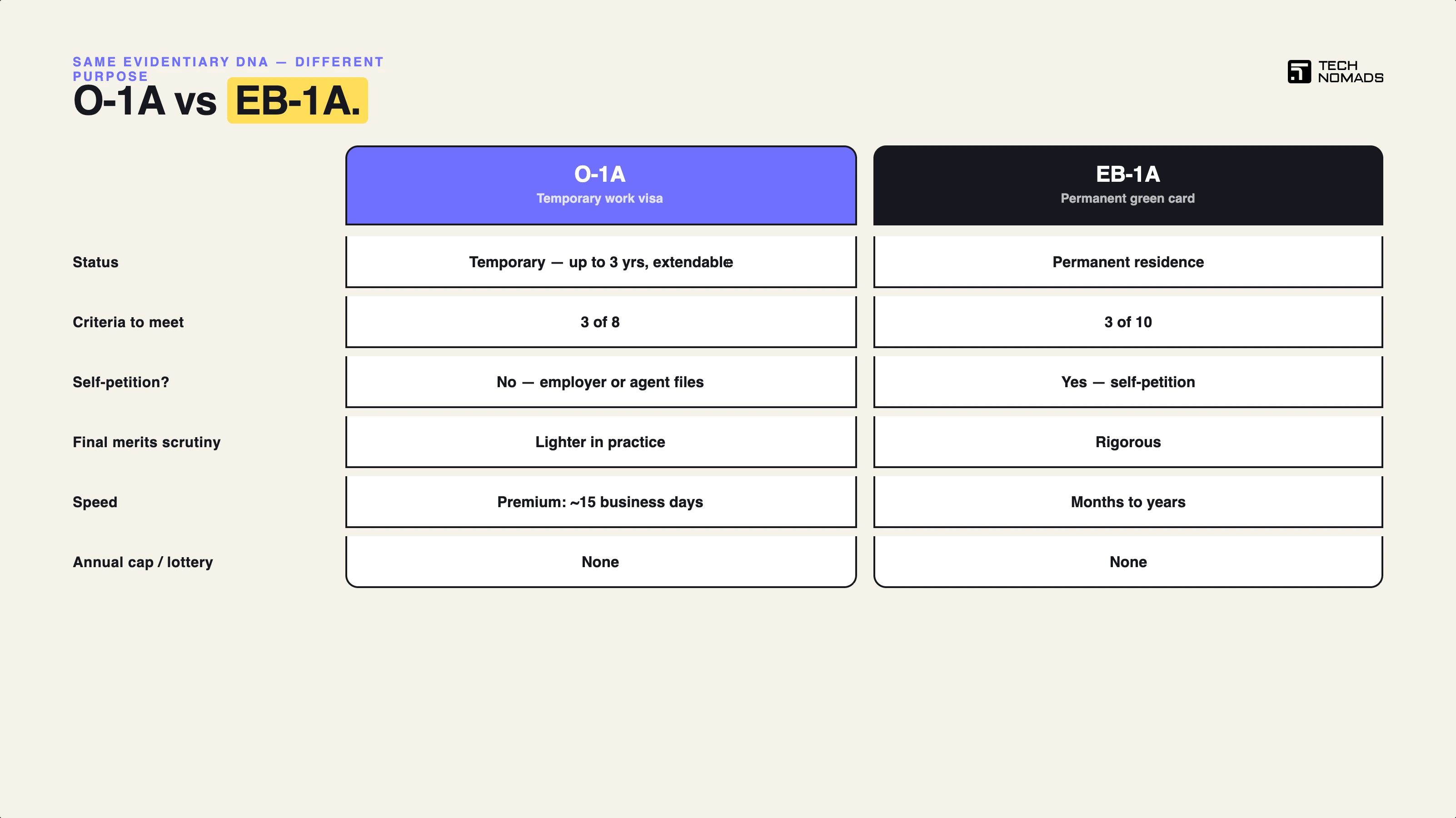
Unlike the EB-1A green card, the O-1A is not a path to permanent residency in itself. It grants temporary authorisation to work in the United States for a specific employer or agent, for a specific period, in the specific field in which extraordinary ability has been demonstrated. It does not confer the right to remain in the US permanently, and holders must either extend the visa, change status, or depart when their authorised period of stay ends.
What the O-1A offers that most other work visas do not is the combination of relatively accessible eligibility criteria, similar to but not identical with the EB-1A standard, with a filing process that does not require the applicant to have a permanent US job offer, does not require a labour market test, and is not subject to an annual numerical cap. There are no O-1A visa lottery draws. If you qualify and your employer or agent files a complete petition, you will receive the visa.
(Source: USCIS — O-1 Visa: Individuals with Extraordinary Ability or Achievement)
Eligibility at a Glance
Mandatory Eligibility Criteria
The O-1A eligibility standard requires that the petitioner demonstrate extraordinary ability in the sciences, education, business, or athletics through sustained national or international acclaim. USCIS defines this as a level of expertise indicating that the person is one of the small percentage who have risen to the very top of their field.
The first path is evidence of a one-time achievement that is a major internationally recognised award, equivalent in standing to a Nobel Prize, Pulitzer Prize, Olympic medal, or similar. In practice, very few O-1A petitions are built on this basis.
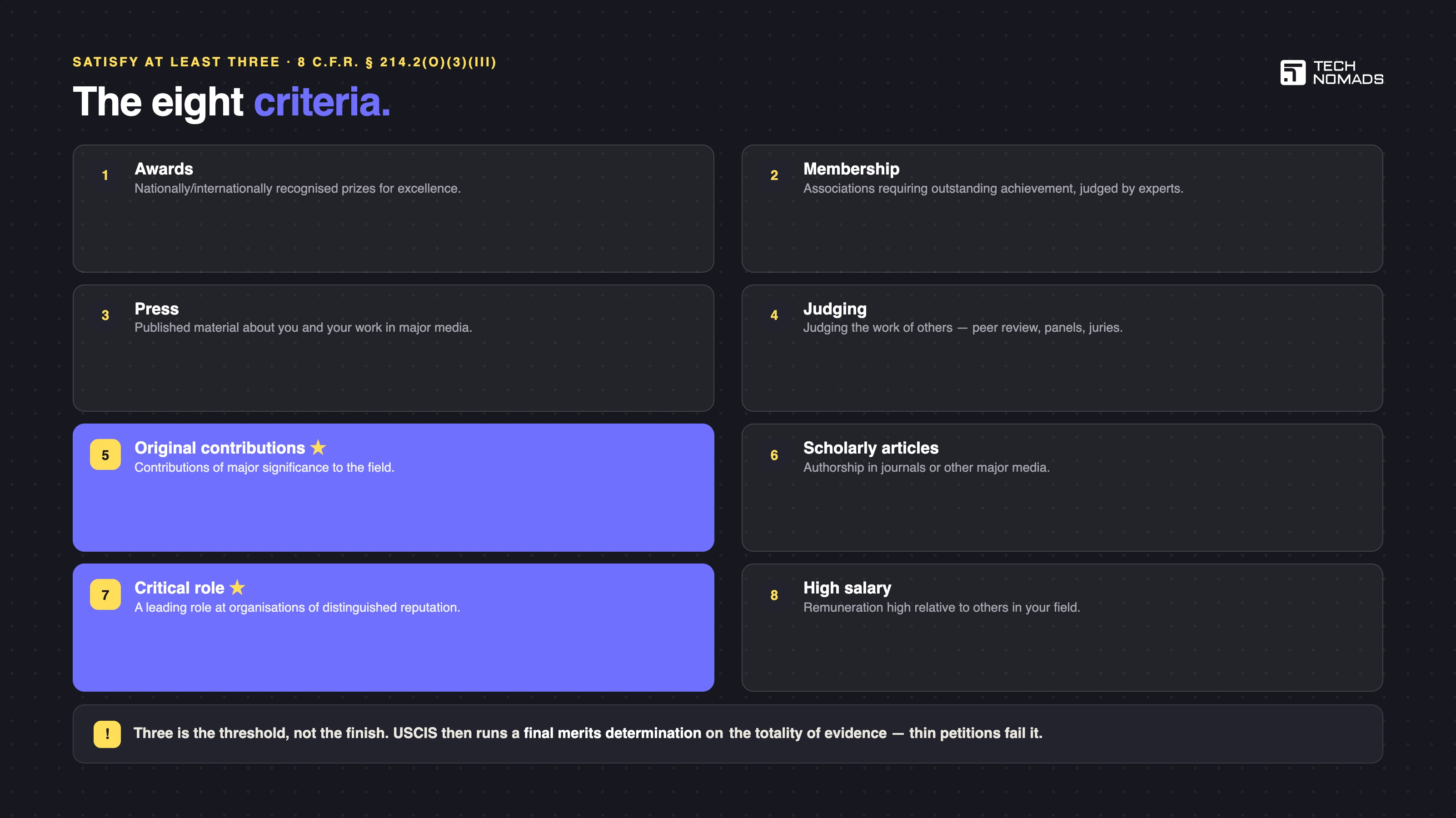
The second path — used by the overwhelming majority of O-1A petitioners is demonstrating evidence across at least three of the following eight criteria. These criteria are published in the O-1A regulations at 8 C.F.R. § 214.2(o)(3)(iii):
Criterion 1 — Awards: Receipt of nationally or internationally recognised prizes or awards for excellence in the field of endeavour. These must be competitive awards in which the applicant was selected on the basis of excellence, not participation or membership awards.
Criterion 2 — Membership: Membership in associations in the field that require outstanding achievements of their members, as judged by recognised national or international experts. This is similar to the EB-1A criterion but applies a similar standard of selectivity.
Criterion 3 — Press: Published material in professional or major trade publications or major media about the person and the person's work in the field. The coverage must be about the petitioner specifically, not merely work in which the petitioner participated.
Criterion 4 — Judging: Participation, either individually or on a panel, as a judge of the work of others in the same or an allied field of specialisation. Peer review, grant panel membership, hackathon judging, and editorial board participation are among the most common forms of qualifying evidence.
Criterion 5 — Original contributions: Evidence of original scientific, scholarly, or business-related contributions of major significance in the field. This is one of the most substantively demanding criteria — contributions must be demonstrably significant, not merely competent or incremental.
Criterion 6 — Scholarly articles: Authorship of scholarly articles in the field, in professional journals, or other major media. For tech professionals, this extends beyond academic publication to include widely-read technical articles in authoritative publications or platforms.
Criterion 7 — Critical role: Evidence that the person has performed in a leading or critical role for organisations or establishments that have a distinguished reputation. Senior technical roles, founding roles, or principal contributor roles at recognised technology companies or research institutions are the most common evidence for this criterion.
Criterion 8 — High salary: Evidence that the person has commanded and continues to command a high salary or other remuneration for services, evidenced by contracts or other reliable evidence. The salary must be demonstrated to be high relative to others in the field, not merely high in absolute terms.
(Source: 8 C.F.R. § 214.2(o)(3)(iii); USCIS Policy Manual Volume 2, Part M)
Meeting three criteria is the threshold — but it is not sufficient on its own. USCIS then conducts a final merits determination of whether the totality of the evidence establishes extraordinary ability and sustained acclaim. A petition that barely clears three criteria on thin evidence will typically not survive this second step.
Document and Evidence Requirements
An O-1A petition is filed on Form I-129 (Petition for a Nonimmigrant Worker) by the petitioner's employer or agent. The filing must include the following:
The completed and signed Form I-129 with the O supplement. The filing fee, currently $730 for Form I-129 as of the USCIS fee schedule effective 1 April 2024, plus $2,805 for optional premium processing via Form I-907. A written consultation from a peer group, labour organisation, or person with expertise in the field is formally required for O-1A petitions, though USCIS may waive the requirement in certain circumstances. A copy of any written contracts between the petitioner and the employer or agent, or a summary of the terms of the oral agreement. An itinerary of the events or activities for which the visa is sought, if applicable. Evidence supporting each criterion claimed is presented in a clear, organised, criterion-by-criterion format. A cover letter or brief explaining why the totality of the evidence establishes extraordinary ability.
If applying for an O-1 visa stamp at a US Embassy or Consulate abroad rather than filing for a change of status inside the US, the applicant also completes the DS-160 online non-immigrant visa application and attends a consular interview.
Common Refusal Reasons
Based on USCIS published policy and Kazarian framework adjudication, the most consistent grounds for O-1A petition denial are as follows.
Failure to meet three criteria is the most straightforward ground. Petitioners who assert criteria on thin evidence or who mischaracterise their achievements as meeting a criterion they do not actually satisfy, fall at the first analytical step.
Weak evidence for the original contributions criterion is among the most frequently cited specific weaknesses. Stating that someone has made original contributions without specifically explaining the nature of those contributions, their significance to the field, and independent corroboration of that significance is the most common way to fail this criterion.
Press coverage that is not about the petitioner specifically, coverage of a company, a product, or a project in which the petitioner was involved, without specifically addressing the petitioner's individual contribution or standing, does not satisfy the published material criterion.
Advisory opinion letters that are too generic, praising the petitioner's skills without addressing the legal standard of extraordinary ability and sustained acclaim, add little value and may signal to the adjudicator that the petitioner's standing cannot be established with specificity.
Salary evidence without comparative data fails the high salary criterion. The evidence must demonstrate that the salary is high relative to others in the same field and at a comparable career level, not merely that the salary is high in absolute terms.
The O-1A application process has two or three stages, depending on whether the applicant is applying from inside or outside the United States.
Stage 1 — I-129 Petition
The employer or agent files Form I-129 with USCIS. This is the core petition establishing extraordinary ability. It includes the written consultation, the itinerary or description of services, the evidence for each criterion, and the cover letter. USCIS adjudicates the petition and issues an approval or a Request for Evidence (RFE), or in some cases a denial.
Filing options are standard processing — currently three to six months or premium processing via Form I-907, which targets a 15-business-day initial decision at an additional cost of $2,805.
Stage 2A — Change of Status (if inside the US)
Applicants already in the US in a valid non-immigrant status, such as an H-1B, F-1, or another O-1A, may request a change of status as part of the I-129 petition without leaving the country. The change of status takes effect upon I-129 approval.
Stage 2B — Visa Stamp (if outside the US or travelling)
Applicants outside the US, or O-1A holders who travel internationally and need to re-enter, must obtain an O-1 visa stamp at a US Embassy or Consulate. This requires scheduling a visa appointment, completing the DS-160 application, and attending a consular interview. Processing times at US Embassies vary significantly by location.
Extensions
O-1A status may be extended in one-year increments by filing a new I-129 petition before the current period of authorised stay expires. There is no statutory limit on extensions, and a new written consultation is not always required for extensions with the same employer. Each extension petition is adjudicated on its current merits — the prior approval does not guarantee renewal.
O-1A Transfer
An O-1A holder who changes employers must have a new I-129 petition filed by the new employer before beginning work. The new petition may be filed concurrently with the period of work commencing. O-1A portability provisions allow the holder to begin working for the new employer upon filing, provided the petition is non-frivolous. This is commonly referred to as an O-1 visa transfer.
Cost & Processing Time at a Glance
Filing fees (as of USCIS fee schedule, April 2024)
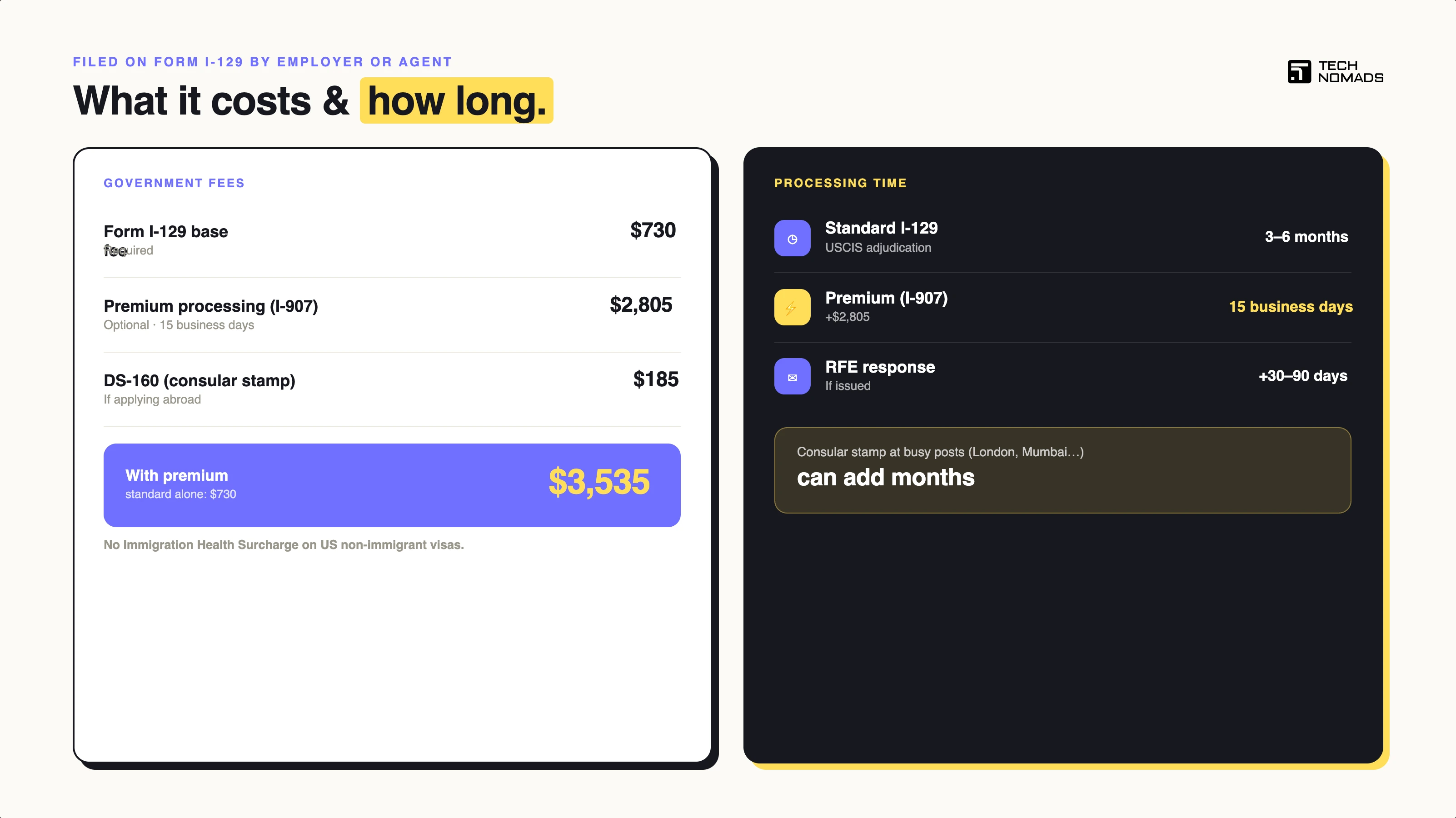
The Form I-129 base filing fee is $730. Optional premium processing via Form I-907 costs an additional $2,805, targeting a 15-business-day initial decision. If a visa stamp is required at a US Embassy, the DS-160 non-immigrant visa application fee is $185. There is no equivalent of the UK's Immigration Health Surcharge on US non-immigrant visas.
Processing times
Standard I-129 processing currently takes between three and six months, depending on the USCIS service centre processing the petition and the current caseload. Premium processing targets 15 business days for an initial decision — either an approval, a Request for Evidence, or, in rare cases, a denial. A Request for Evidence extends the timeline by the time taken to prepare and submit the response, which is typically 30–90 days, depending on complexity.
Consular processing for a visa stamp at a US Embassy varies widely by post. High-demand posts — including London, Mumbai, and several others — have appointment wait times that can extend to several months. Applicants who need to travel to the US on a specific date should factor the consular processing time into their timeline planning.
Total estimated government cost per petition: Standard processing — $730. Premium processing — $3,535. With a consular visa stamp — add $185.
The O-1A Visa is a non-immigrant visa; it does not lead to permanent residency directly. However, it is widely used as a strategic stepping stone towards a green card, particularly the EB-1A (Extraordinary Ability) and EB-2 NIW (National Interest Waiver).
The O-1A and the EB-1A use similar evidentiary frameworks — both require extraordinary ability through sustained national or international acclaim, and both assess evidence against a list of published criteria. The O-1A standard is generally considered marginally more accessible in practice, partly because the O-1A adjudication process involves less rigorous final merits scrutiny in many cases. An applicant who receives an O-1A approval has demonstrated a meaningful level of professional standing, but an O-1A approval does not guarantee EB-1A approval and should not be treated as such.
The strategic value of the O-1A as a precursor to the EB-1A is that it allows the applicant to establish a US presence — building additional evidence, developing US-based peer relationships, accumulating US-specific professional recognition — while the EB-1A petition is being prepared or while the applicant's profile continues to develop. Many successful EB-1A petitioners held O-1A status for one to three years before filing their green card petition.
For applicants whose profile does not yet meet the EB-1A standard but who qualify for the EB-2 NIW, the O-1A similarly provides a lawful status in which to work in the US while the NIW petition is pending. EB-2 NIW petitions can take twelve to twenty-four months or longer to result in a green card for applicants from most countries — the O-1A bridges this gap.
O-1A holders who are simultaneously pursuing a green card benefit from maintaining a valid O-1A status throughout the green card process. If the I-485 adjustment of status application has not yet been filed or approved, continued O-1A status provides the legal basis for remaining in the US.
The O-1A to green card pathway in practice:
Most applicants follow one of two routes. The first is filing an EB-1A self-petition concurrently with or shortly after securing O-1A status, with the intention of completing the green card process within two to four years. The second is using the O-1A to establish a US presence over two to five years, building additional evidence during that period, and filing the EB-1A petition once the profile is materially stronger than it was at the time of the O-1A filing.
In either case, the O-1A is not a destination — it is a vehicle. The long-term goal for most O-1A holders in the technology sector is permanent residency, and the O-1A is most valuable when it is treated as part of a deliberate immigration strategy rather than an end in itself.
(Source: USCIS — EB-1 Visa; USCIS — EB-2 Visa & NIW)
The O-1A Visa process demands more than familiarity with the USCIS form instructions. Building a compelling, extraordinary ability case — selecting the right criteria, gathering the right evidence, drafting a personal statement that maps achievements to the legal standard, and managing the employer or agent filing relationship — requires both immigration expertise and a deep understanding of how professional achievements in technology, research, and entrepreneurship translate into the USCIS evidentiary framework.
Working with Tech Nomads on an O-1A application means receiving a detailed eligibility assessment before any filing commitment is made, so you know whether your profile is ready, which criteria you can credibly claim, and what evidence gaps, if any, should be addressed first. For applicants who are ready to file, Tech Nomads provides end-to-end support from petition strategy through to filing, including evidence structuring, cover letter drafting, advisory opinion letter guidance, and representation through any Request for Evidence response.
Tech Nomads is a global mobility platform that provides services for international relocation. Established in 2018, Tech Nomads has a track record of successfully relocating talents and teams. Our expertise in adapting to regulatory changes ensures our clients’ satisfaction and success.
Tech Nomads Club
Tech Nomads Club is a curated global community for highly skilled professionals.
We host free, application-based events, including expert panel talks, start-up pitch days, members-only networking, informal meetups, and fireside conversations with industry leaders.
Membership is free but selective — open to those building across borders and seeking meaningful growth through connection, knowledge, and community.
We also produce a regular podcast that shares real stories, insights, and voices from inside the Club.
Book a Consultation
Ready to find out whether the O-1A Visa is the right route for your profile — and how it fits into your longer-term US immigration strategy?
The Tech Nomads team offers personalised consultations for tech professionals, researchers, and founders at every stage of the process. In a single session, you will receive a clear, specific assessment of your profile against the O-1A criteria, honest advice on whether you are ready to file or what needs to be strengthened first, and a view of how the O-1A connects to your green card pathway.
To explore your USA relocation options, you may:
Subscribe to our social media platforms to stay up-to-date on global mobility news and opportunities:
Useful Resources:





Information made available on this website in any form is for information purposes only. It is not, and should not be taken as advice. You should not rely on, or take or fail to take any action based upon this information.
© Copyright 2024, All Rights Reserved

.png)
.png)
.png)

.avif)


.png)