.png)
Seek more insights? Subscribe to our Monthly Newsletter
The EB-1 green card is permanent residency from the moment it is granted. This is one of the most fundamental distinctions between the EB-1 and most other US immigration categories, and it shapes everything about the post-approval experience. An EB-1 green card holder does not renew a visa. They do not report to USCIS. They do not maintain a relationship with any employer or sponsor. What they hold is unconditional lawful permanent resident status — the right to live and work in the United States indefinitely.
This article addresses the questions that EB-1 green card holders most commonly ask after approval: how the green card is maintained, when it needs to be renewed in a physical sense, what the pathway to US citizenship looks like, what happens if circumstances change, and how Tech Nomads supports long-term planning for individuals and families navigating the permanent residency journey. All information is drawn from official USCIS published guidance and the Immigration and Nationality Act.
Renewal Eligibility and Timing
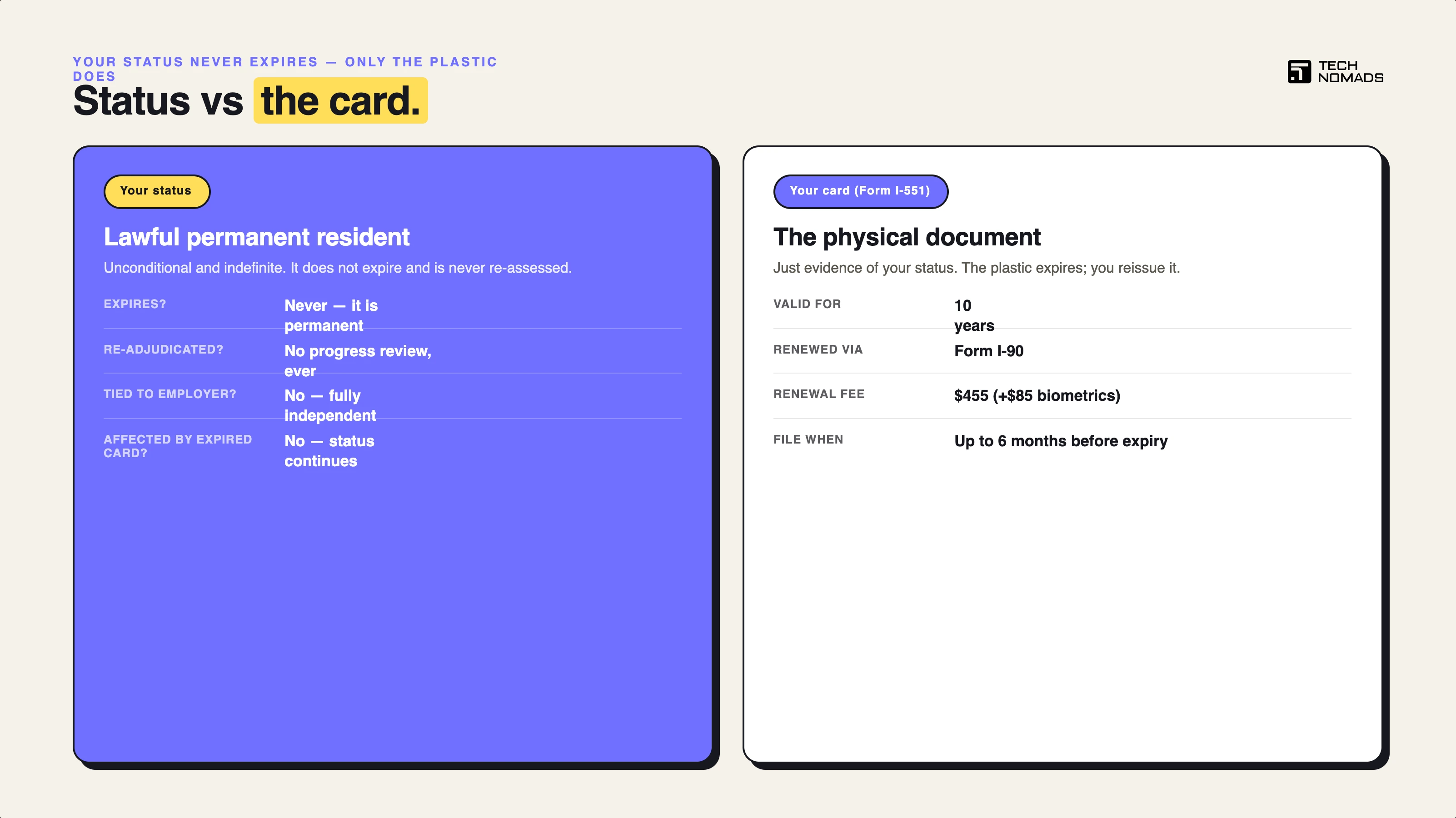
The distinction between renewing the EB-1 visa and renewing the green card is important. The EB-1 immigrant visa — the document that permitted entry to the US when the applicant first arrived as a permanent resident is a one-time entry document. It is not renewed. What is periodically renewed is the Permanent Resident Card (Form I-551, commonly called the green card), the physical document that evidences the holder's lawful permanent resident status.
The green card itself is issued with a ten-year validity period for most permanent residents. It must be renewed before it expires. Importantly, the expiry of the physical card does not affect the underlying status — a person remains a lawful permanent resident even with an expired card, but an expired card cannot be used as evidence of work authorisation, and re-entry to the US after international travel requires a valid card or a valid re-entry permit.
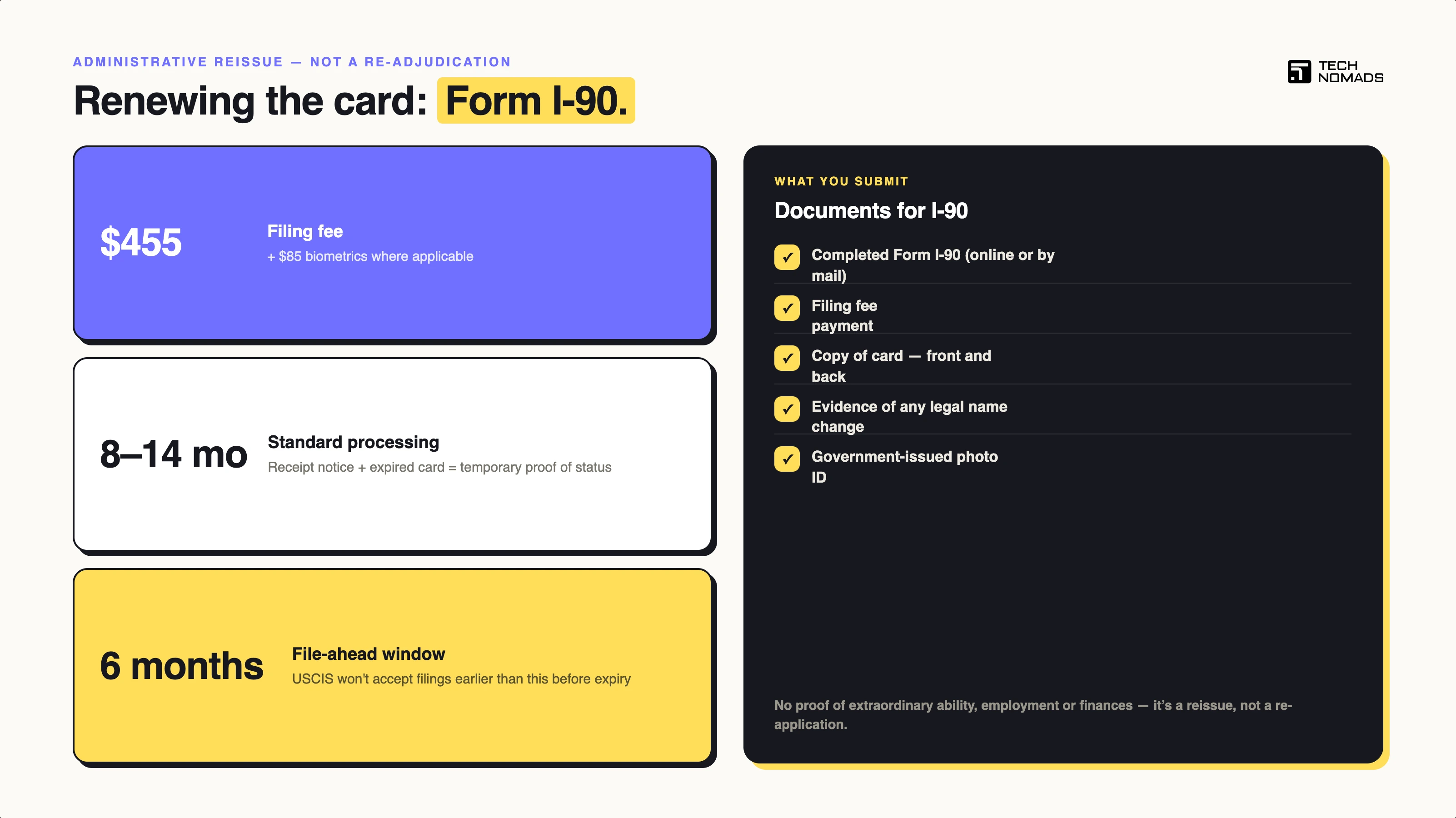
Green card renewal process: The green card is renewed by filing Form I-90 (Application to Replace Permanent Resident Card) with USCIS. This is an administrative process, not a new immigration petition. It does not require demonstrating extraordinary ability again, does not require a new employer or sponsor, and does not involve a new adjudication of immigration eligibility. The filing fee for Form I-90 is $455 (plus an $85 biometrics fee where applicable) as of the USCIS fee schedule effective April 2024.
USCIS recommends filing Form I-90 up to six months before the card's expiry date. Processing times vary but typically range from eight to fourteen months under standard processing. During the pending period, USCIS issues a receipt notice which, combined with the expired card, serves as temporary evidence of status for most purposes, including employment verification.
Conditional permanent residents — those who obtained their green card through marriage and whose status was granted conditionally must file Form I-751 to remove conditions before the two-year conditional period expires. This does not apply to EB-1 green card holders, whose status is unconditional from the outset.
(Source: USCIS, Form I-90 instructions; USCIS fee schedule, April 2024)
Documents Required for Renewal
The Form I-90 filing requires the following:
The completed and signed Form I-90 is filed online via the USCIS website or by mail. The filing fee of $455 paid by credit card, check, or money order. The expiring or expired Permanent Resident Card. A copy of the front and back of the current card. Evidence of any name change if the name on the card no longer matches the applicant's legal name.
No evidence of extraordinary ability, employment, or financial standing is required for a standard green card renewal. The renewal is simply a reissuance of the physical card evidencing an existing, unconditional immigration status.
Pathway to Permanent Residency / ILR / Green Card
For applicants who have not yet received their green card — those who are in the process of the EB-1 green card application the pathway consists of two stages: the I-140 petition establishing extraordinary ability, followed by either adjustment of status (Form I-485, for applicants inside the US) or consular processing (DS-260, for applicants outside the US).
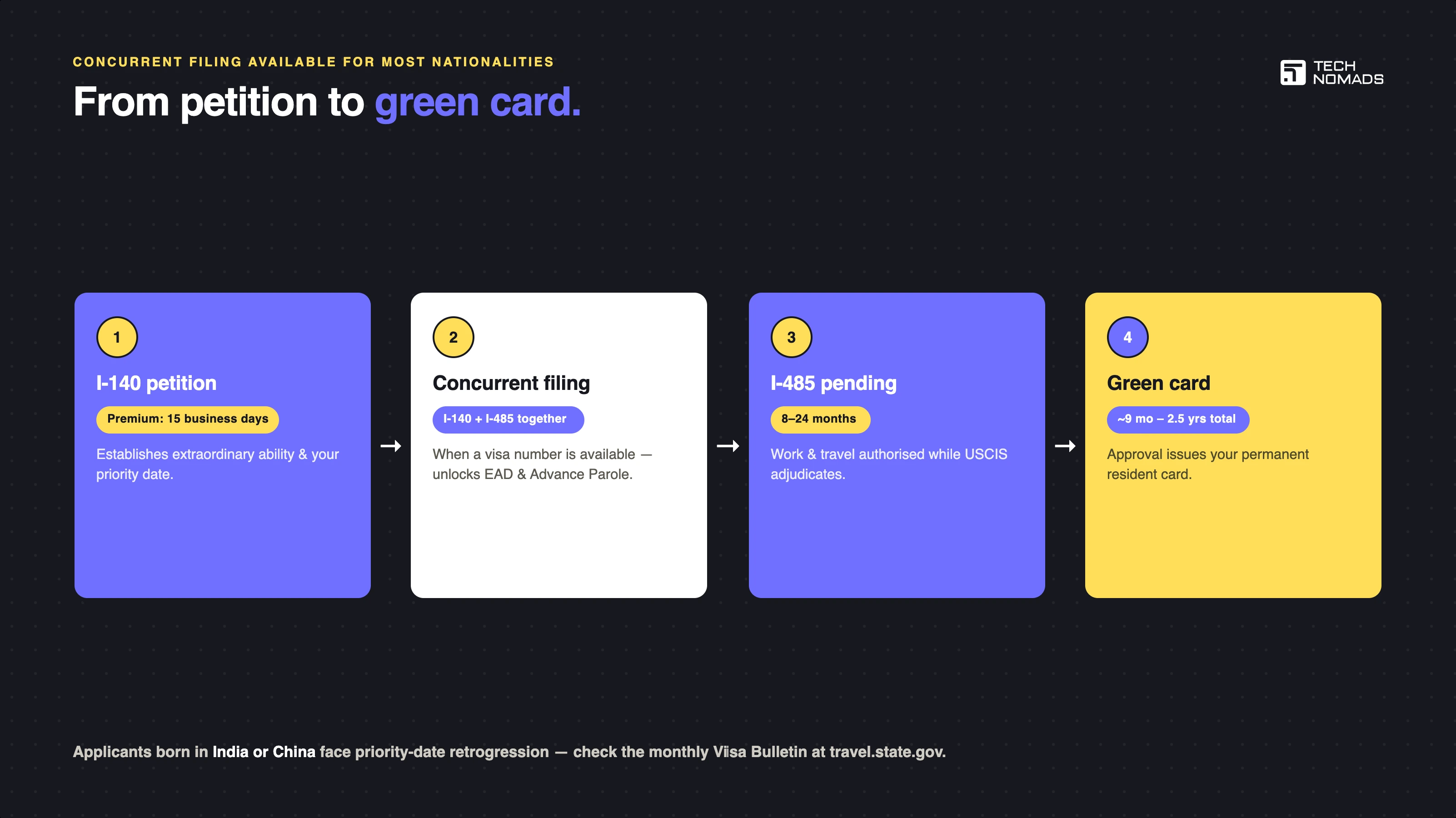
The I-140 approval establishes the priority date, the date the petition was filed, which determines the applicant's place in the queue for a green card number. For most nationalities in the EB-1 category, priority dates are current, meaning there is no significant wait between I-140 approval and the ability to file or proceed with the green card stage. Applicants born in India or China face priority date retrogression and should consult the current Visa Bulletin at travel.state.gov for their specific situation.
Once a visa number is available, adjustment of status applicants file Form I-485 and receive an Employment Authorisation Document (EAD) and Advance Parole during the pending period. I-485 approval results in the issuance of the green card. Consular processing applicants attend an immigrant visa interview at a US Embassy and enter the US as lawful permanent residents.
Permanent Residency / ILR / Green Card Pathway
The EB-1 green card — formally the alien of extraordinary ability green card for EB-1A holders confers full lawful permanent resident status upon approval. There is no conditional period, no progress assessment, and no ongoing obligation to USCIS. From the moment the green card is approved, the holder is a permanent resident with the full rights that entail.
Pathway to Permanent Residency / ILR / Green Card
For those still navigating the eb1 green card process, the key milestones are as follows.
The I-140 petition is filed with USCIS and, if approved with premium processing, receives an initial decision within 15 business days. Standard processing takes four to six months. I-140 approval does not itself grant any immigration status; it is the petition that establishes eligibility.
Concurrent filing — submitting the I-140 and I-485 together is available when a visa number is immediately available, which it currently is for most nationalities on the EB-1 category. Concurrent filing allows the applicant to obtain work authorisation (EAD) and travel authorisation (Advance Parole) while the green card application is pending, and removes the need to maintain a separate non-immigrant status during the process.
For applicants who cannot file concurrently, because they are outside the US or because their priority date is not current, the I-140 may be filed and approved while the applicant waits for a visa number to become available. An approved I-140 retains its priority date indefinitely, even if the petitioner changes employer or moves to a different visa category, provided it is not formally revoked.
Timeline from I-140 filing to green card (most nationalities): I-140 premium processing decision: 15 business days. I-485 processing: eight to 24 months, depending on the field office and caseload. Total from I-140 filing to green card approval: approximately nine months to two and a half years under typical conditions.
(Source: USCIS processing times; USCIS Policy Manual Volume 6, Part F)
For green card holders renewing the physical card via Form I-90, the requirements are straightforward and administrative in nature; there is no substantive immigration reassessment. The key requirements are that the holder is still a lawful permanent resident (their status has not been abandoned or terminated), that their identity matches the records on file with USCIS, and that the filing is complete and accurate.
For applicants who have not yet received their green card and are completing the eb1 green card application process either through I-485 adjustment of status or consular processing, the requirements are more substantive.
I-485 requirements for EB-1A self-petitioners: The applicant must have an approved I-140 with a current priority date. They must be admissible to the United States — meaning no bars to admission under the Immigration and Nationality Act apply. They must have been inspected and admitted or paroled into the US in a lawful status. They must pass a medical examination conducted by a USCIS-designated civil surgeon (Form I-693). They must provide biometrics. They must not have committed acts that would render them inadmissible on criminal, security, or other grounds.
There is no requirement for an ongoing employment relationship with any employer for EB-1A green card holders. The self-petition basis means that the underlying extraordinary ability, not any employment arrangement, is the foundation of the status. A change of employer, a period of freelance work, or even a gap in employment does not affect the EB-1A green card application or the underlying status once it is granted.
Medical examination: The Form I-693 medical examination must be completed by a USCIS-designated civil surgeon. It covers vaccination requirements, physical examination, and a review of medical history. The completed form is sealed by the civil surgeon and submitted with the I-485 filing. Form I-693 results are valid for two years from the date of the civil surgeon's signature, or until the I-485 is adjudicated, whichever comes first.
(Source: USCIS, Form I-485 instructions; USCIS, Form I-693 instructions)
Documents and Evidence Needed
For Form I-90 (green card renewal): Completed Form I-90. Filing fee payment ($455 plus $85 biometrics where applicable). Copy of the front and back of the expiring or expired card. Evidence of any legal name change, if applicable. Government-issued photo identification.
For Form I-485 (adjustment of status — EB-1A): Completed Form I-485. Filing fee: $1,440 for applicants aged 14–78 (as of USCIS fee schedule, April 2024), which includes the biometrics fee. Two passport-style photographs meeting USCIS specifications. Copy of the approved I-140 approval notice (Form I-797). Copy of all passports and travel documents. Copy of birth certificate with certified English translation. Copy of any prior immigration documents (visas, prior green cards, employment authorisation documents). Police certificates from each country where the applicant has lived for six months or more since age 16 (where required, consult USCIS instructions for current requirements). Completed Form I-693 medical examination (sealed by civil surgeon). Form I-864 Affidavit of Support — note that for EB-1A self-petitioners, the Affidavit of Support requirement is generally waived because the basis of the petition is extraordinary ability rather than employment, and the applicant has demonstrated the ability to support themselves. Legal practitioners should confirm the current USCIS position on this at the time of filing.
For Form I-765 (Employment Authorization Document — filed concurrently with I-485): Completed Form I-765. No additional fee when filed with I-485.
For Form I-131 (Advance Parole — filed concurrently with I-485): Completed Form I-131. No additional fee when filed with I-485.
(Source: USCIS Form I-485 instructions; USCIS fee schedule, April 2024)
Green card renewal (Form I-90): USCIS recommends filing up to six months before the card's expiry date. Filing too early, more than six months before expiry, is not accepted. Filing too late risks a gap in the ability to use the card for employment verification and travel. The most reliable approach is to file at the six-month mark and maintain a copy of the I-90 receipt notice alongside the expiring card as evidence of pending renewal.
Re-entry permit: Green card holders who plan to travel outside the US for more than one year or who are uncertain whether their travel will exceed one year should file Form I-131 for a re-entry permit before departing. A re-entry permit is valid for two years and allows re-entry to the US without the presumption of abandonment of permanent resident status that attaches to absences of one year or more without a permit. Filing for a re-entry permit does not guarantee that status has been maintained it simply removes the automatic presumption of abandonment.
Citizenship timing: For most EB-1 green card holders, the earliest citizenship application date is five years after the date the green card was approved. For those married to US citizens and living together as a couple, the qualifying period is three years. The naturalisation application (Form N-400) may be filed up to 90 days before the qualifying period is complete. Filing early, more than 90 days before the five-year mark, results in rejection of the application.
Priority date strategy for pending applicants: For applicants whose I-140 is approved but whose priority date is not yet current, primarily those born in India or China, the timing of the I-485 filing depends entirely on the monthly Visa Bulletin. Applicants should monitor the Visa Bulletin closely and be ready to file promptly when their priority date becomes current, as dates can retrogress. USCIS announces each month whether concurrent filing is available under the "Dates for Filing" chart or must wait for the "Final Action Dates" chart — this distinction affects when I-485 can be filed and is updated monthly.
What Changes if Your Situation Has Changed
Change of employer: An EB-1A green card holder may change employers freely, at any time, without notifying USCIS. The green card is not tied to an employer. The holder may work for any employer, become self-employed, start a company, or combine multiple roles. There is no immigration consequence to any employment change. This employer independence is one of the EB-1A's most significant practical advantages.
Change of field: The EB-1A petition was filed based on extraordinary ability in a specific field. Once the green card is approved, there is no ongoing obligation to work in that field. A permanent resident is free to work in any field, any industry, or any role. However, for applicants whose I-140 is approved but I-485 is still pending — particularly those waiting on priority date movement a significant change in the field of intended employment could theoretically affect the petition basis. Legal advice should be sought in this situation.
Marriage or divorce: A change in marital status after the green card is approved has no effect on the underlying status. Newly married spouses of permanent residents may be eligible for immigrant visas as immediate relatives, but this is a separate immigration petition process and does not affect the primary holder's status. Divorce similarly does not affect the primary holder's green card.
Criminal conviction or civil penalty: Any criminal conviction, including misdemeanours, should be assessed for its potential effect on permanent resident status and future naturalisation eligibility. Certain convictions can render a permanent resident deportable or permanently ineligible for naturalisation. Legal advice should be sought promptly following any arrest or conviction.
Extended absences from the US: A lawful permanent resident who remains outside the US for more than one year without a re-entry permit, or more than two years with a re-entry permit, risks being found to have abandoned their permanent resident status. Additionally, extended absences may break the continuous residence requirement for naturalisation — absences of more than one year generally break continuous residence, though there are exceptions for certain employment situations. Permanent residents planning extended stays abroad should plan carefully and consult immigration counsel before departing.
Citizenship Next Steps
US citizenship naturalisation is available to lawful permanent residents who meet the following requirements under the Immigration and Nationality Act and USCIS naturalisation guidance.
Five-year rule: The applicant must have been a lawful permanent resident for at least five years immediately before filing. The five years are counted from the date the green card was approved (for adjustment of status applicants) or from the date of entry as a permanent resident (for consular processing applicants).
Three-year rule (spouse of US citizen): An applicant who has been married to and living with a US citizen for at least three years, and has been a permanent resident for at least three years, may apply after three years rather than five.
Physical presence: The applicant must have been physically present in the US for at least 30 months of the five years (or 18 months of the three years). Individual absences of more than six months but less than one year may disrupt continuous residence unless the applicant can demonstrate they did not abandon their US residence.
Continuous residence: The applicant must have continuously resided in the US during the qualifying period. An absence of more than one year generally breaks continuous residence, resetting the qualifying period.
State residence: The applicant must have lived in the state or USCIS district where they are filing for at least three months before filing.
English language: The applicant must be able to read, write, and speak basic English. Exemptions apply for applicants aged 50 or older who have been permanent residents for 20 years, aged 55 or older for 15 years, or those with certain physical or developmental disabilities.
Civics: The applicant must pass a civics test covering US history and government. The test is administered orally at the naturalisation interview. Study materials are published by USCIS.
Good moral character: The applicant must demonstrate good moral character during the qualifying period and continuing up to the oath ceremony. Certain criminal convictions, tax violations, or immigration fraud permanently bar naturalisation.
The naturalisation timeline for EB-1 green card holders:
For most nationalities, the EB-1A green card is obtainable within one to two years of filing, meaning citizenship eligibility can be reached in six to seven years from the start of the immigration process or sooner, where the I-140 and I-485 are processed quickly and concurrent filing is available.
What citizenship confers: US citizenship grants the right to vote in federal, state, and local elections. The right to hold a US passport, with visa-free or visa-on-arrival access to the large majority of countries worldwide. The right to pass citizenship to children born abroad. Immunity from deportation — a citizen cannot be removed from the US for any reason. Access to federal employment positions that require citizenship. The right to sponsor a broader range of family members for immigration, including parents, siblings, and adult children.
The US permits dual nationality in most circumstances — becoming a US citizen does not automatically require renouncing citizenship of another country, though some countries do not permit dual nationality, and applicants should verify their home country's position before naturalising.
(Source: Immigration and Nationality Act §§ 316, 319; USCIS, A Guide to Naturalization, 2024)
Navigating the EB-1 Visa process — from building a compelling extraordinary ability case to managing the green card stage requires more than familiarity with the forms. It requires a partner who understands both the legal standard and the practical reality of relocating your life and career to the United States.
Tech Nomads is a global mobility platform specialising in international relocation for talented professionals and teams. Established in 2018, Tech Nomads has built a track record of successfully guiding individuals through complex USA visa processes, including the EB-1, with personalised strategies tailored to each client's profile, timeline, and goals.
What sets Tech Nomads apart:
Tech Nomads Club
Tech Nomads Club is a curated global community for highly skilled professionals.
We host free, application-based events, including expert panel talks, start-up pitch days, members-only networking, informal meetups, and fireside conversations with industry leaders.
Membership is free but selective — open to those building across borders and seeking meaningful growth through connection, knowledge, and community.
We also produce a regular podcast that shares real stories, insights, and voices from inside the Club.
Book a Consultation
Ready to find out whether the EB-1 Visa is the right route for your profile?
The Tech Nomads team offers personalised consultations for professionals considering the EB-1A extraordinary ability petition. You will get a clear picture of where your profile stands against the USCIS criteria, what evidence would strengthen your case, and what a realistic timeline and process looks like for your specific situation.
To explore your USA relocation options, you may:
Subscribe to our social media platforms to stay up-to-date on global mobility news and opportunities:
Useful Resources:





Information made available on this website in any form is for information purposes only. It is not, and should not be taken as advice. You should not rely on, or take or fail to take any action based upon this information.
© Copyright 2024, All Rights Reserved

.png)
.png)
.png)

.avif)


.png)