.png)
Seek more insights? Subscribe to our Monthly Newsletter
Receiving an endorsement letter from an approved endorsing body is a significant milestone, but it is not the end of the process. It is the beginning of Stage 2. The endorsement confirms that your business concept meets the mandatory criteria. It does not grant you a visa, authorise you to live or work in the UK, or guarantee anything about the three years that follow.
This article guides UK Innovator Founder Visa holders and applicants through everything that happens after endorsement — the Stage 2 visa application, the obligations that attach to the leave once it is granted, the progress meeting structure, renewal, and the path to ILR and citizenship.
What the Endorsement Letter Confirms
The endorsement letter from the approved endorsing body confirms three things: that your business concept is innovative, that it is viable, and that it is scalable as assessed by the endorsing body against the mandatory criteria set out in the Immigration Rules. It confirms that the endorsing body is willing to support your application and to take on the ongoing monitoring role that the route requires.
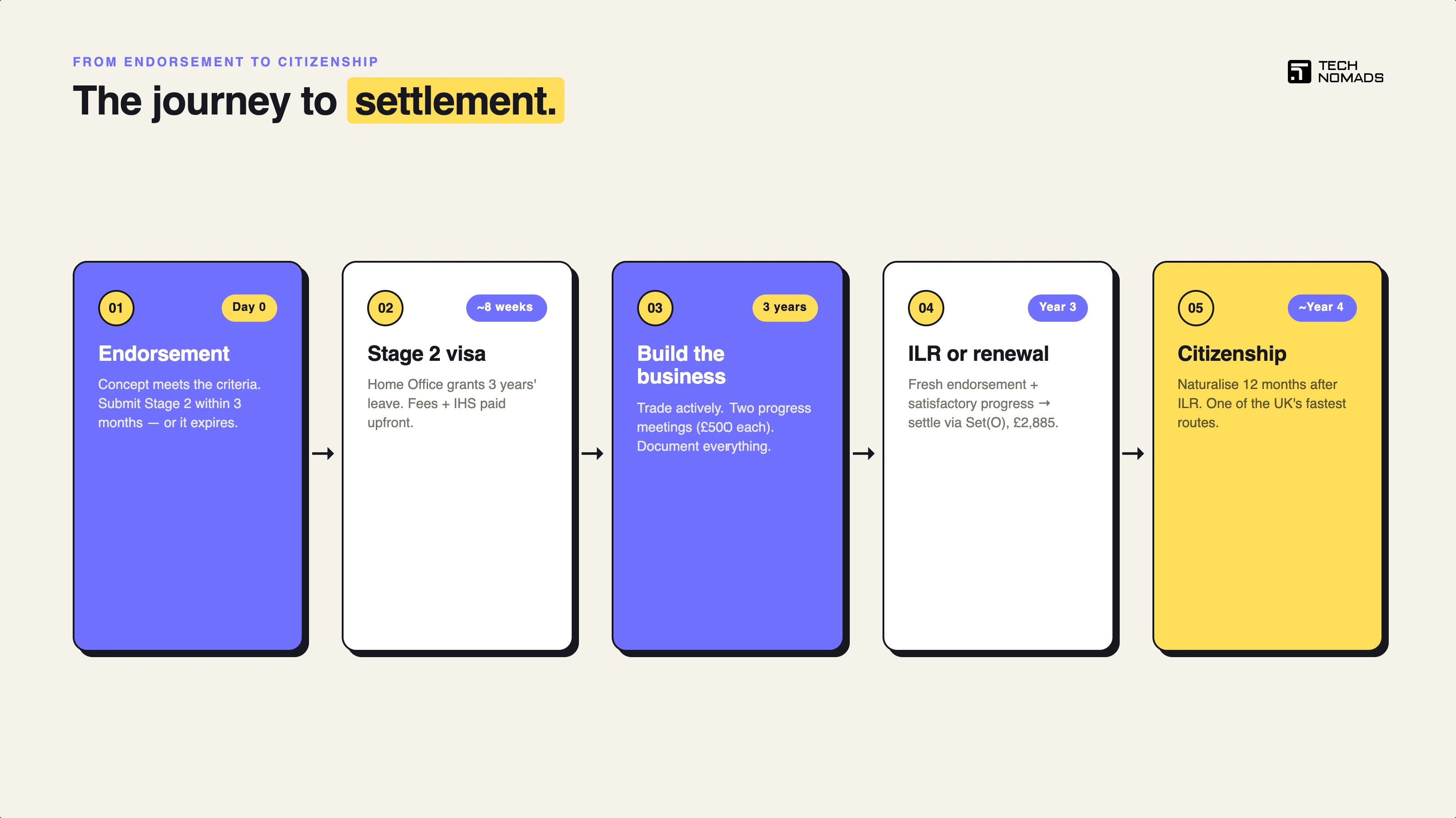
The endorsement letter is a time-limited document. It must be used, that is, the Stage 2 visa application must be submitted within three months of the date of the endorsement. An endorsement that expires before the visa application is submitted is invalid, and the applicant must obtain a new endorsement before proceeding.
What Changes Immediately After Endorsement
In practical terms, very little changes immediately after endorsement. The endorsement itself does not grant any immigration status, does not authorise work in the UK, and does not affect any existing visa or leave the applicant holds. It is a prerequisite for Stage 2, not an immigration status in its own right.
What changes is the applicant's position in the process: they now have the document they need to submit the Stage 2 visa application to the Home Office. The clock on the three-month validity window begins running from the date on the endorsement letter.
Common Misconceptions About Endorsement
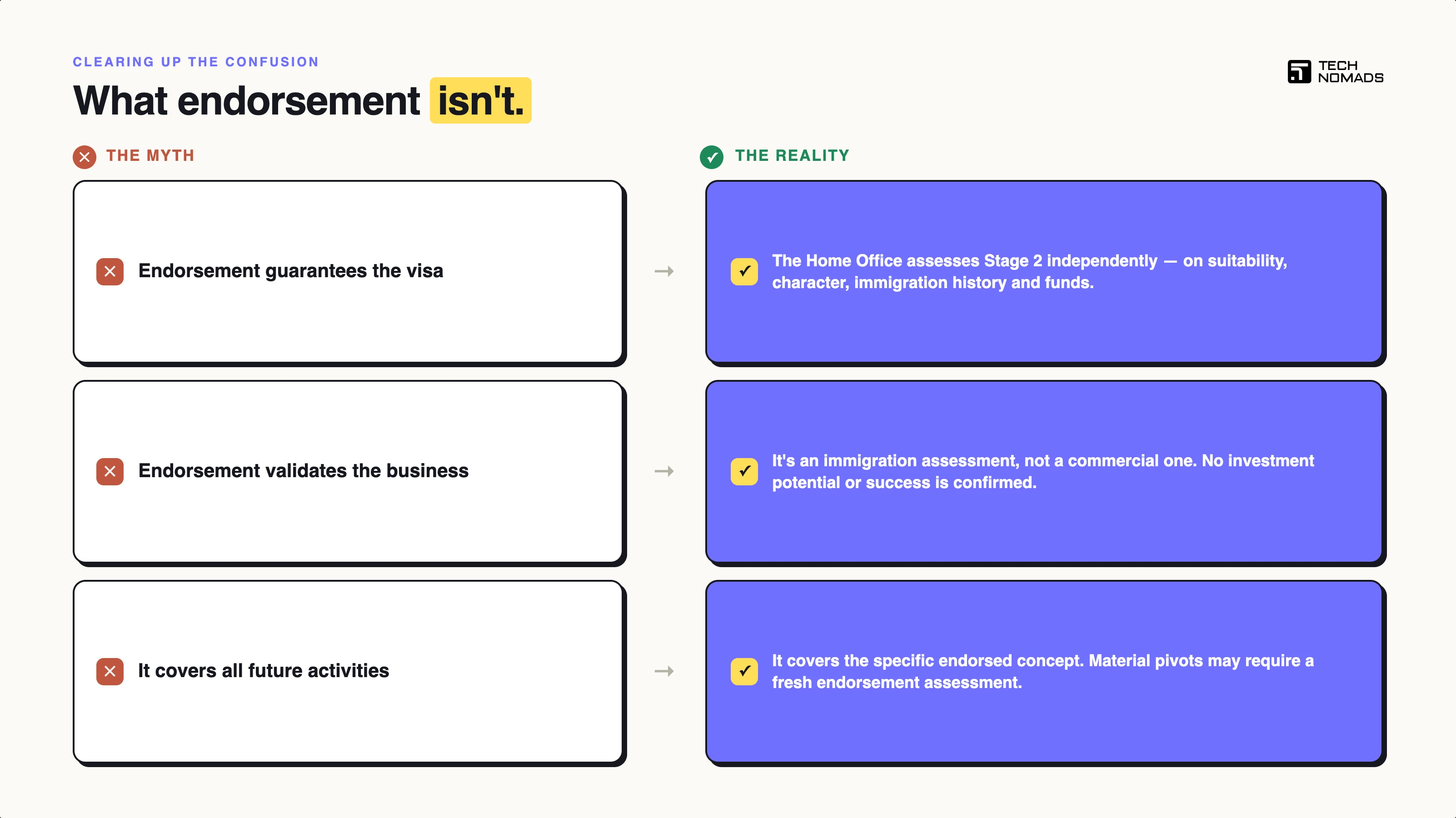
Misconception 1: Endorsement guarantees the visa: It does not. The Home Office assesses the Stage 2 application independently. In practice, Stage 2 refusals are rare where a valid endorsement has been obtained; the substantive gatekeeping occurs at endorsement, but the Home Office retains discretion on suitability grounds, including character, immigration history, and maintenance of funds.
Misconception 2: Endorsement means the business is validated: The endorsing body has assessed the concept against the three criteria. It has not validated the business commercially, assessed its investment potential, or confirmed that it will succeed. The endorsement is an immigration assessment, not a commercial endorsement.
Misconception 3: Endorsement covers all future business activities: The endorsement covers the specific business concept described in the application. Significant changes to the business model, sector, or concept after endorsement may require a new endorsement assessment. Holders should maintain the endorsed business as described and discuss any material changes with their endorsing body before making them.
Submitting the Stage 2 Visa Application
The Stage 2 application is submitted to the Home Office via the UKVI online portal. The applicant must submit the application within three months of the date of the endorsement letter. Late submission, even by one day, invalidates the endorsement, and a new endorsement must be obtained before reapplying.
What Stage 2 requires:
A completed online application via the UKVI portal. The endorsement letter from the approved endorsing body. A valid passport or travel document. Payment of the visa application fee — currently £1,357 per person for applicants applying from outside the UK, or £1,693 for in-country extensions or switches, plus the Immigration Health Surcharge at £1,035 per year of leave requested, paid in full upfront. For a three-year grant, the IHS is £3,105 per person. Biometric enrolment at a UKVCAS service point or equivalent. Evidence of maintenance funds — the applicant must demonstrate they have sufficient funds to support themselves in the UK, currently £945 held for at least 90 consecutive days before the date of application, unless the endorsing body has certified on the endorsement letter that it will cover costs for the first month.
Processing times:
The Home Office targets approximately eight weeks for standard Innovator Founder Visa Stage 2 processing. Priority processing is available at an additional cost and targets a faster decision. Applicants with time-sensitive travel or employment arrangements should factor processing time into their planning.
Dependants — a spouse or civil partner and unmarried children under 18 may be included in the application or apply separately. Each dependant pays the same visa application fee and IHS rate as the principal applicant.
(Source: gov.uk/innovator-founder-visa; Home Office Immigration and Nationality fees schedule, April 2025)
For applicants who have processed the visa through a UK Embassy or Consulate abroad, arrival in the UK as an Innovator Founder Visa holder triggers several immediate practical steps.
Register with the police (if required): Some nationalities are required to register with the police within seven days of arrival. Check whether this requirement applies to your nationality before travelling.
Create a UKVI account and access your eVisa: From 2025, most new visa holders receive their immigration status as a digital eVisa rather than a physical Biometric Residence Permit. Applicants should ensure they have created a UKVI account and can access and share their eVisa before they need to use it — for employment checks, rental applications, or other purposes.
Notify your endorsing body of your arrival: While not always a formal requirement, most endorsing bodies expect to hear from endorsed visa holders promptly after arrival to begin the monitoring relationship. Check your endorsing body's specific requirements.
Open a UK bank account: Most UK banks require proof of address and immigration status to open a current account. The eVisa or UKVI status sharing link serves as evidence of immigration status. Opening a bank account early simplifies paying suppliers, receiving revenue, and registering with HMRC.
Register with HMRC: As a self-employed person or company director, you must register with HMRC for self-assessment tax. The registration process depends on your business structure — sole trader, limited company, or partnership. Registration should be completed promptly after beginning to trade, not deferred until the first tax return is due.
Register the company at Companies House: If operating as a limited company, which most Innovator Founder Visa holders do, the company must be incorporated at Companies House. This can be done before arrival if the business is being established in advance, or promptly after arrival if not yet done.
Your Obligations as an Innovator Founder Visa Holder
The Innovator Founder Visa carries ongoing obligations that distinguish it from most other UK work visas. Failing to meet these obligations risks the endorsing body withdrawing its endorsement, which would affect the holder's ability to renew the visa and ultimately to settle.
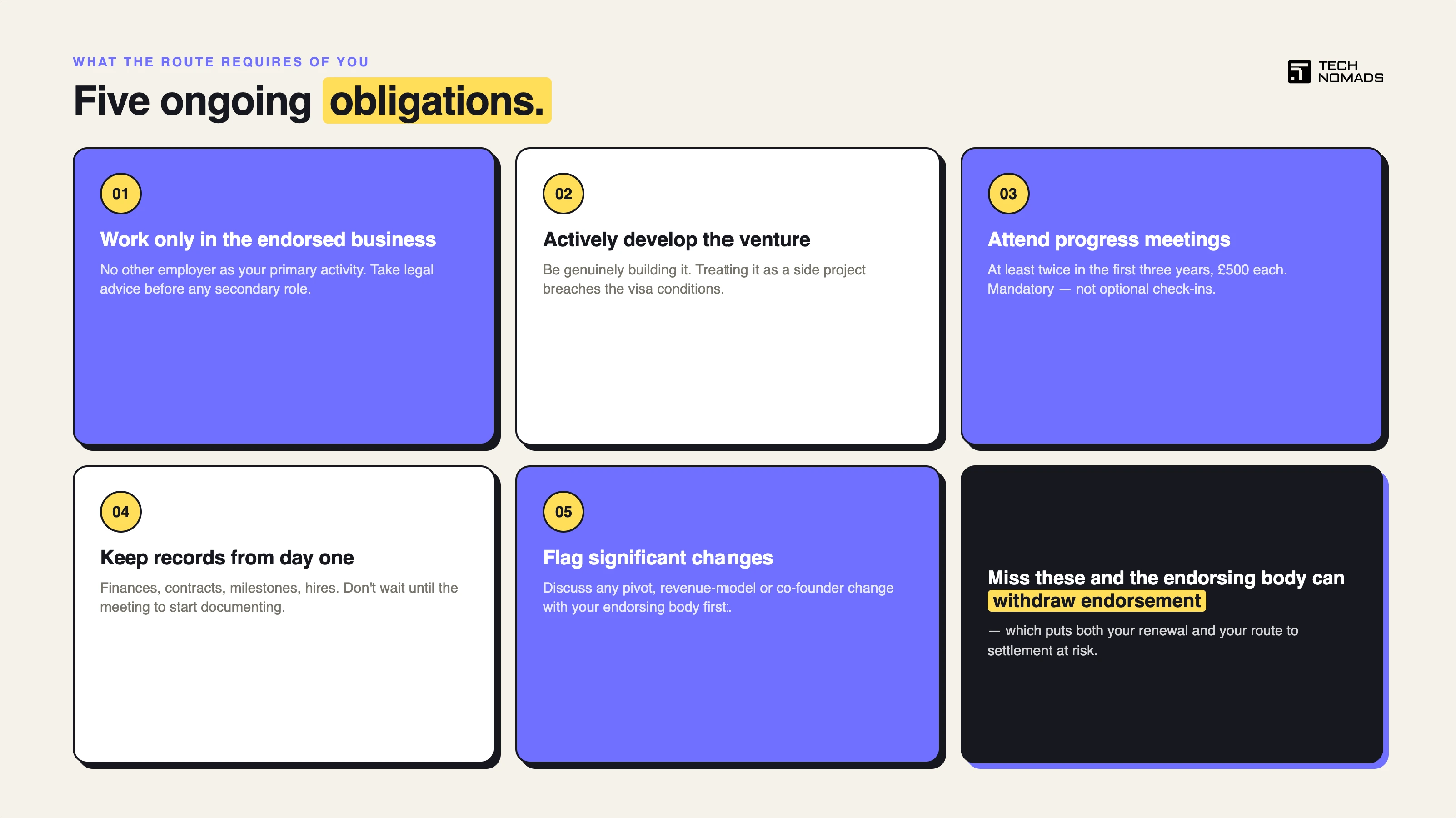
Work only in the endorsed business: The visa grants leave to work in the endorsed business. The holder may not take up employment with another employer as their primary activity, though supplementary employment in certain circumstances is permissible — legal advice should be sought before taking on any secondary employment arrangement.
Actively develop the business: The visa requires the holder to be genuinely working on the endorsed venture. A holder who is not actively developing the business, who has taken on a full-time employed role and is treating the venture as secondary, for example, is in breach of the visa conditions.
Attend progress meetings: The holder must meet with the endorsing body at least twice during the initial three-year period of leave. These meetings cost £500 each and are mandatory — they are not optional check-ins. The endorsing body uses these meetings to assess whether the business has progressed satisfactorily against the criteria endorsed at the outset.
Maintain records of business activity: The endorsing body will assess progress at each meeting. Holders should maintain clear, organised records of business activity — financial records, customer contracts, product development milestones, team hires, and any other evidence of the business's development from the date of arrival. Do not wait until the first progress meeting to begin this documentation.
Notify the endorsing body of significant changes: Material changes to the business concept — a pivot to a different sector, a fundamental change in the revenue model, or a change in co-founder arrangements should be discussed with the endorsing body before being implemented. An unannounced material change may raise concerns at the progress meeting.
What the Endorsing Body Assesses at the Progress Meeting
The progress meeting is not a casual conversation. It is a structured assessment of whether the business has developed in a way that is consistent with the concept endorsed at the outset, and whether the mandatory criteria: innovative, viable, scalable continue to be met by the business as it has evolved.
The endorsing body will typically ask about: what the business has achieved since the last assessment; how the business compares to the financial and operational projections in the original business plan; what challenges have been encountered and how they have been addressed; what the next stage of development looks like; and whether any significant changes have been made to the concept, model, or team.
How to Document Your Business Progress
The most effective preparation for a progress meeting is continuous, organised documentation throughout the period since the last assessment, not a retrospective compilation in the week before the meeting.
Useful evidence includes: financial records showing revenue, expenses, and company accounts; customer contracts, letters of intent, or sales data; product development records — releases, user growth, engagement metrics; team records any hires made, advisers engaged, or partnerships formed; press coverage or other independent recognition of the business's development; and any awards, accelerator participation, or investor engagement that has occurred.
Organise this evidence in a clear, chronological format that tells the story of the business's development since the endorsed concept was submitted. The endorsing body is assessing whether you have been actively building the venture — the documentation should make that case compellingly.
What Happens If Your Business Has Not Progressed as Planned
Not every business develops exactly as projected. Markets shift, products pivot, and early assumptions prove incorrect. The endorsing body is not expecting the original business plan to have been executed perfectly — it is assessing whether the founder has been genuinely working on the venture and whether the business continues to meet the mandatory criteria in its current form.
The most important thing a holder can do when the business has not progressed as planned is to be transparent and prepared. Acknowledge the gap between projection and reality, explain the reasons factually, describe what has been learned, and present a credible revised plan. An endorsing body that sees an honest, well-reasoned account of a challenging period is in a very different position from one that encounters unexplained stagnation and vague reassurances.
If the business has fundamentally failed, if trading has ceased, if the concept has proven unworkable, or if the founder is no longer working on it, the holder should seek immediate legal advice. The endorsing body may withdraw its endorsement, which would trigger a curtailment of leave and require the holder to make alternative immigration arrangements promptly.
The initial Innovator Founder Visa grant is for three years. At or before expiry, the holder must either apply for ILR (if they have met the continuous residence and satisfactory progress requirements) or apply for a further grant of leave on the same route.
Renewal requirements:
A new endorsement from the same or a different approved endorsing body, confirming that the business continues to meet the mandatory criteria and has made satisfactory progress. The Stage 2 visa application must be submitted to the Home Office within three months of the new endorsement. Payment of the visa application fee (£1,693 for in-country extension) and IHS (£1,035 per year of leave requested). Evidence of continuous residence and maintenance of funds.
The renewal endorsement is not simply a reconfirmation of the original — it is a fresh assessment of the business as it now exists. The endorsing body will assess whether the business continues to be innovative, viable, and scalable in its current form, and whether the progress made during the initial three-year period is satisfactory.
A holder whose business has materially changed since the original endorsement — through a legitimate pivot or natural evolution; should be prepared to explain the change and demonstrate that the business in its current form still meets the criteria. A change that is well-evidenced and commercially credible is unlikely to cause difficulties. A change that appears to abandon the endorsed concept without justification may raise concerns.
The ILR Application for Innovator Founder Visa Holders
Innovator Founder Visa settlement is available after three years of continuous residence on the route, provided the holder can demonstrate satisfactory progress in the business. This is one of the fastest routes to ILR available under the UK immigration system — comparable to the Global Talent Visa Exceptional Talent route.
The ILR application is made on Form Set(O), submitted online via the UKVI portal. The current fee is £2,885 per applicant. The Life in the UK Test must be passed before applying. There is no English language requirement on the Innovator Founder route at any stage, including ILR.
Continuous residence requires no absence from the UK of more than 180 days in any rolling 12-month period during the three-year qualifying period. Absences for business travel, family reasons, or holidays are compatible with continuous residence, provided this limit is respected.
Satisfactory Progress — What It Means at Settlement
The ILR assessment for Innovator Founder Visa holders includes a substantive review of business progress — not simply a residence check. The Home Office, in conjunction with the endorsing body, assesses whether the business has developed in line with the endorsed concept and whether the founder has been continuously and actively working on it throughout the qualifying period.
Evidence of satisfactory progress includes: financial records demonstrating the business is active and trading; Companies House filings showing the company remains in good standing; evidence of customers, revenue, or other commercial traction; evidence of the founder's ongoing active involvement; and a letter from the endorsing body confirming satisfactory progress at the most recent progress meeting.
Holders whose businesses have not progressed substantially or who cannot demonstrate continuous active involvement may face difficulties at ILR. The three years of the initial grant are not simply a residency period; they are a period of active business development that must be evidenced.
Following ILR approval, British citizenship (naturalisation) is available after a further 12 months, provided the standard requirements are met: physical presence on the date five years before the application, no more than 450 days' absence in the five years, no more than 90 days' absence in the final 12 months, good moral character, and the Life in the UK Test.
For Innovator Founder Visa holders who received ILR after three years, the earliest citizenship eligibility is approximately four years after first arriving in the UK on the visa, making it one of the fastest routes to British citizenship available to non-EEA nationals. The UK permits dual nationality; becoming a British citizen does not require renouncing existing citizenship, though applicants should verify their home country's position before naturalising.
How Tech Nomads Supports Long-Term Planning
The Innovator Founder Visa journey does not end at endorsement — it extends through three years of active business building, at least two progress meetings, a renewal or ILR application, and ultimately citizenship eligibility. Tech Nomads supports holders throughout this journey: from progress meeting preparation and documentation strategy to renewal endorsement support and ILR application guidance.
Tech Nomads is a global mobility platform that provides services for international relocation. Established in 2018, Tech Nomads has a track record of successfully relocating talents and teams. Our expertise in adapting to regulatory changes ensures our clients’ satisfaction and success.
Tech Nomads Club
Tech Nomads Club is a curated global community for highly skilled professionals.
We host free, application-based events, including expert panel talks, start-up pitch days, members-only networking, informal meetups, and fireside conversations with industry leaders.
Membership is free but selective — open to those building across borders and seeking meaningful growth through connection, knowledge, and community.
We also produce a regular podcast that shares real stories, insights, and voices from inside the Club.
Book a Consultation
Ready to find out whether the UK Global Talent Visa (Arts & Culture) is the right route for your profile?
To explore your UK relocation options, you may:
Subscribe to our social media platforms to stay up-to-date on global mobility news and opportunities:
Useful Resources:





Information made available on this website in any form is for information purposes only. It is not, and should not be taken as advice. You should not rely on, or take or fail to take any action based upon this information.
© Copyright 2024, All Rights Reserved

.png)
.png)
.png)

.avif)


.png)