.png)
Seek more insights? Subscribe to our Monthly Newsletter
The UK Innovator Founder Visa endorsement refusal rate sits at approximately 38%. In most refused cases, the underlying business idea has genuine merit — but the application is submitted before the founder, the plan, or the evidence is genuinely ready. The endorsement fee is non-refundable. A refusal creates a record that must be addressed in any reapplication. Submitting too early is one of the most costly and avoidable mistakes in the process.
This article provides a practical, section-by-section innovator founder visa eligibility checklist for 2026 — covering the three mandatory criteria, founder profile, business plan, evidence, endorsing body readiness, and the red flags that indicate you are not yet ready to apply.
This checklist is structured in six sections, each addressing a distinct dimension of readiness. Work through every section honestly before deciding whether to apply. A confident yes to every mandatory item in every section indicates readiness. Any no — particularly in the mandatory criteria or endorsing body sections — indicates a gap that should be addressed before submission.
The checklist is not a guarantee of approval. Endorsement involves subjective expert assessment, and a completed checklist does not substitute for a well-constructed application. What it does is identify the most common and most avoidable grounds for refusal before they cost you the endorsement fee.
Mandatory Criteria Checklist (Innovative, Viable, Scalable)
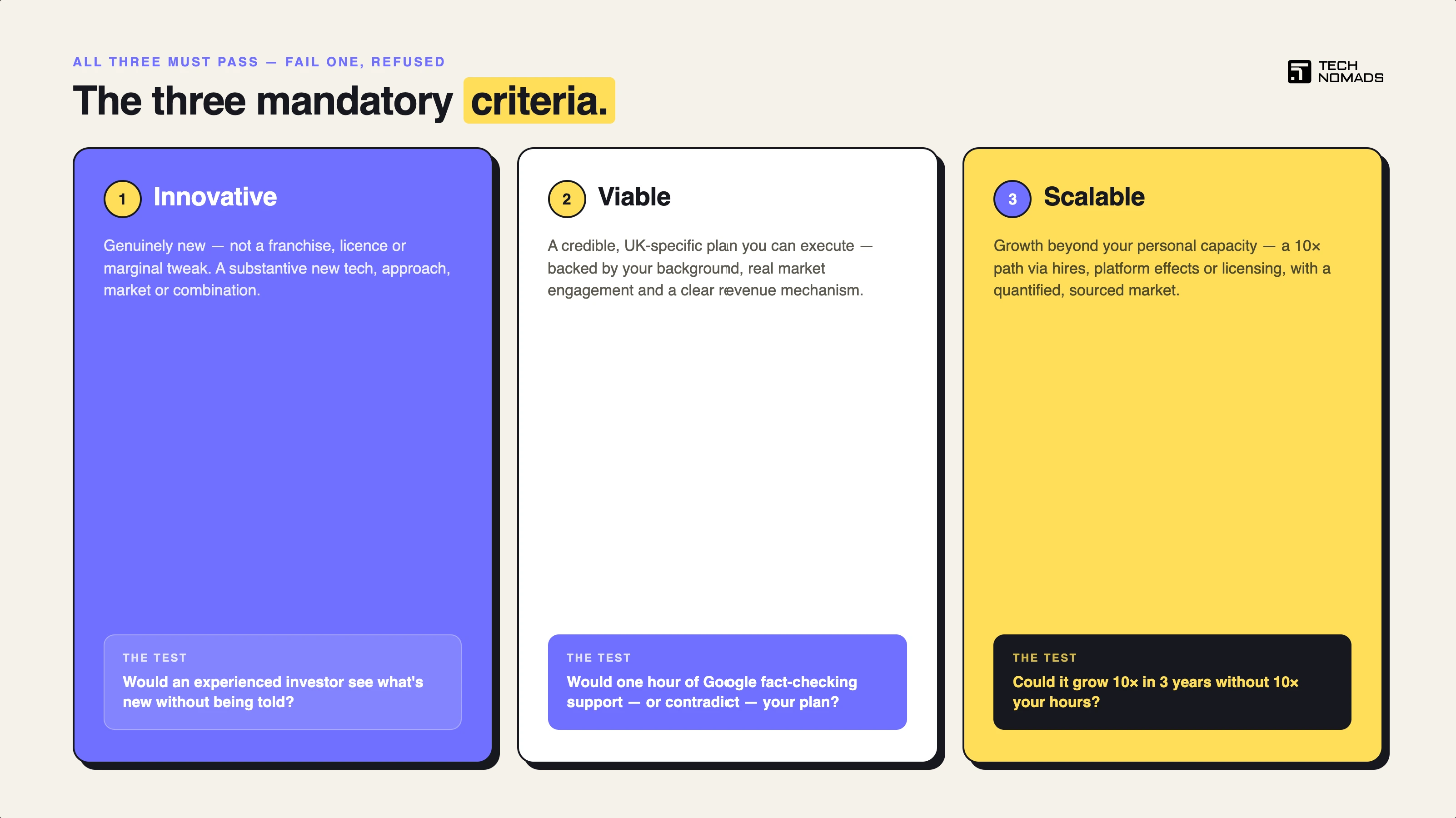
The three mandatory criteria: innovative, viable, and scalable — must all be satisfied. Failing any one results in refusal regardless of the strength of the others. Work through each criterion separately.
Innovative — Is Your Idea Genuinely New?
The test: If an experienced investor in your sector read your business plan, would they immediately understand what is new about your idea, without needing to be told it is new? If the answer requires explanation, the innovative criterion may not be clearly articulated.
Viable — Can You Prove You Can Execute It?
The test: If the endorsing body researcher spent one hour on Google verifying your market assumptions, would the evidence support or contradict your business plan? If contradict, the viable criterion is at risk.
Scalable — Does Your Model Grow Beyond You?
The test: If the business were to grow 10x in three years, would the model allow that without requiring 10x the founder's personal working hours? If the answer is no, the scalable criterion needs addressing.
(Source: gov.uk/innovator-founder-visa/eligibility)
The endorsing body assesses not only the business concept but the founder's ability to execute it. The viable criterion is partly a founder assessment — do you have the specific knowledge, experience, and capability this venture requires?
Domain Knowledge and Relevant Experience
Co-Founder and Team Considerations
Prior Venture History
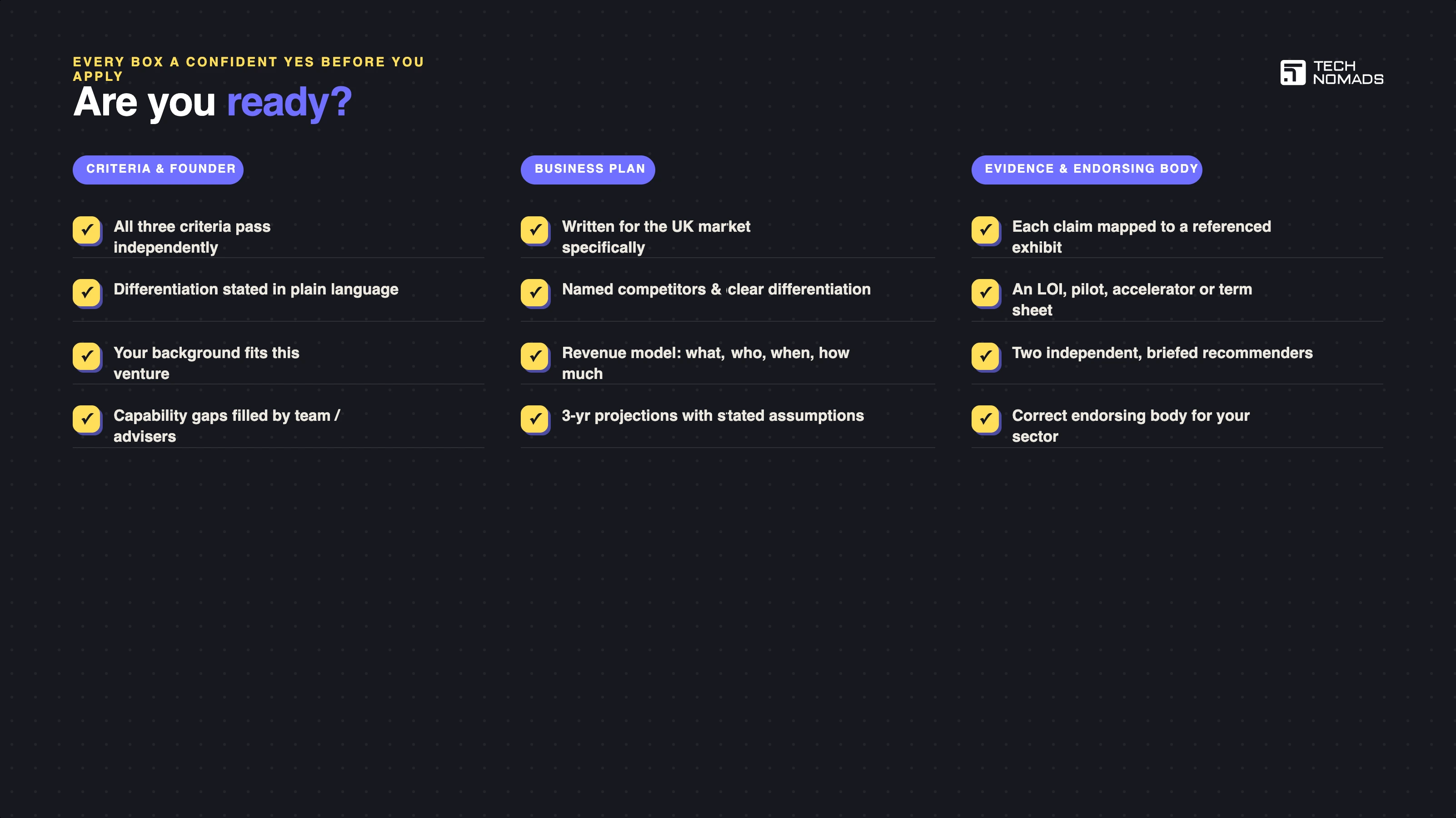
Business Plan Readiness Checklist
The business plan is the central document in the endorsement application. A plan that is vague, generic, or clearly not tailored to the UK market is the single most consistent cause of refusal on the viable criterion.
The realism test: Show your financial projections to someone with no stake in your success and ask: " Do these numbers seem credible given what you know about this market? If the answer is no, the projections need revision before submission.
Evidence for the innovator founder visa criteria must be specific, independently produced, and directly relevant to the criteria being claimed. Assembling evidence without first mapping it to the criteria is a common structural error.
Evidence of innovation:
Evidence of viability:
Evidence of scalability:
Recommendation letters:
Personal statement:
Choosing the right innovator founder visa endorsing body is as important as the quality of the application itself. Each endorsing body has a distinct focus, a portfolio of endorsed businesses, and published criteria that reflect its sector expertise.
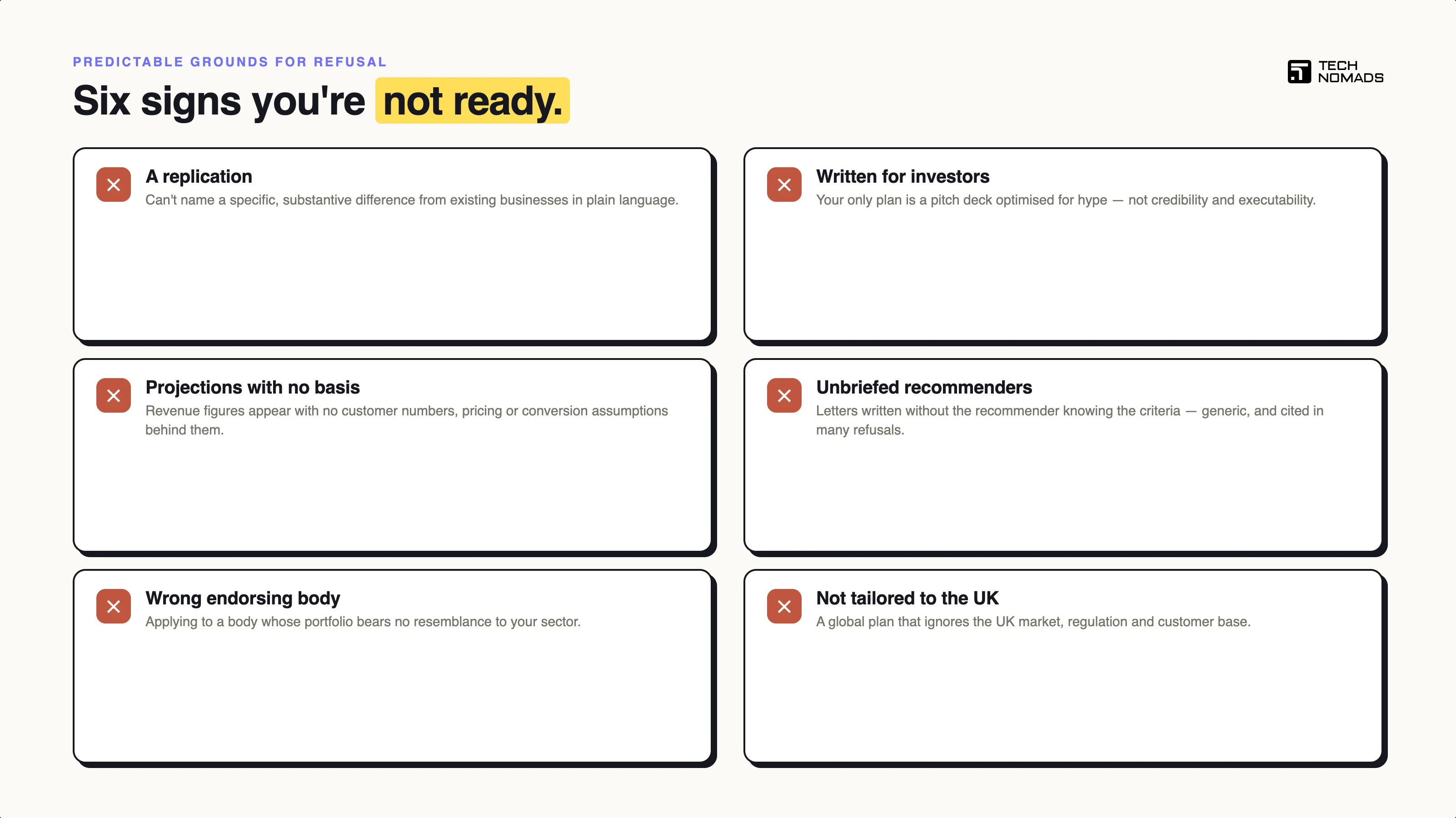
The following indicates that the application is not yet ready for submission. Each is a common and predictable ground for refusal.
Your business idea is a replication: If you cannot articulate a specific, substantive differentiation from existing businesses in plain language, the innovative criterion is not met. A better version of an existing product is not, by itself, innovative in the endorsing body's terms.
Your business plan was written for investors, not for the endorsing body: Investor decks and endorsement business plans serve different purposes. An investor deck optimises for excitement and market size; an endorsement plan must demonstrate credibility and executability. If your only business plan document is a pitch deck, you are not ready.
Your financial projections have no supporting assumptions: Revenue figures that appear without explanation of how they were derived — customer numbers, price per unit, conversion rates, market penetration assumptions are not credible. If you cannot defend every line in your financial model with a specific assumption, the projections are not ready.
Your recommenders have not been briefed on the criteria: A recommendation letter that arrives without the recommender having been told what the endorsing body is looking for will almost certainly be generic. Generic letters are cited in a significant proportion of refusals.
You are applying to the wrong endorsing body: An application to a technology-focused endorsing body for a creative industries venture, or vice versa, signals a fundamental misunderstanding of the route. The endorsing body assesses applications through the lens of its own expertise, and an application outside that lens is unlikely to receive a sympathetic assessment.
Your business plan is not tailored to the UK market: A plan that describes a global opportunity without specifically addressing the UK market, the UK regulatory environment, or the UK customer base is not a UK Innovator Founder Visa business plan. It is a global business plan submitted to a UK endorsing body.
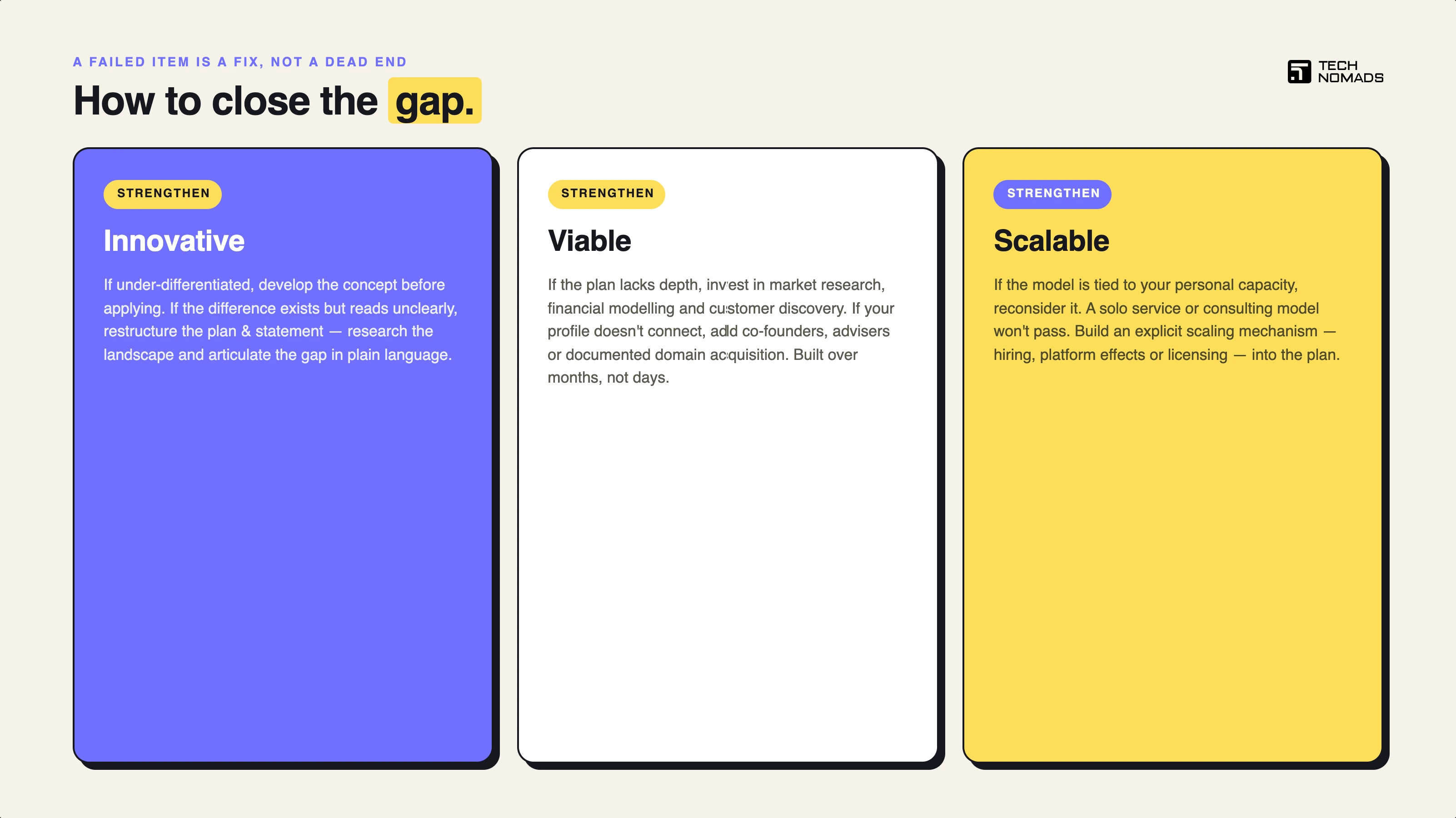
A failed checklist item is not a reason to abandon the application — it is a reason to address the gap before submitting. The appropriate response to each type of failure is different.
Strengthening the Innovative Criterion
If the innovative criterion is weak because the idea is not sufficiently differentiated, the business concept itself may need development before applying. If the criterion is weak because the differentiation exists but is not clearly articulated, the business plan and personal statement need restructuring. Research the competitive landscape more rigorously, document the specific gaps your business addresses, and articulate the differentiation in language that a non-specialist expert can evaluate.
Strengthening the Viable Criterion
If the viable criterion is weak because the business plan lacks depth, invest time in market research, financial modelling, and customer discovery before applying. Conduct primary research — interview potential customers, map the competitive landscape, build a financial model with stated assumptions. If the criterion is weak because your founder profile does not connect to the business, address this through co-founders with relevant experience, advisory relationships with credible sector figures, or documented domain acquisition. A stronger, viable case is built over months, not days.
Strengthening the Scalable Criterion
If the scalable criterion is weak because the business model is structurally constrained to your personal capacity, reconsider the model itself. A consulting practice, a solo service business, or a model that requires the founder's personal delivery at every stage will not satisfy this criterion. Identify the mechanism by which the business scales without requiring proportional increases in your personal time — whether through hiring, platform effects, licensing, or another growth driver — and build that mechanism into the business plan explicitly.
How Tech Nomads Pre-Screens Applications
Tech Nomads works with Innovator Founder Visa applicants to conduct a structured pre-application assessment — working through the mandatory criteria, the founder profile, the business plan, and the evidence before the endorsement fee is paid. The assessment identifies specific gaps and provides actionable guidance on how to address them, so that applicants who proceed to submission do so with a materially stronger case than they would have had without it.
Tech Nomads is a global mobility platform that provides services for international relocation. Established in 2018, Tech Nomads has a track record of successfully relocating talents and teams. Our expertise in adapting to regulatory changes ensures our clients’ satisfaction and success.
Tech Nomads Club
Tech Nomads Club is a curated global community for highly skilled professionals.
We host free, application-based events, including expert panel talks, start-up pitch days, members-only networking, informal meetups, and fireside conversations with industry leaders.
Membership is free but selective — open to those building across borders and seeking meaningful growth through connection, knowledge, and community.
We also produce a regular podcast that shares real stories, insights, and voices from inside the Club.
Book a Consultation
Ready to find out whether the UK Global Talent Visa (Arts & Culture) is the right route for your profile?
To explore your UK relocation options, you may:
Subscribe to our social media platforms to stay up-to-date on global mobility news and opportunities:
Useful Resources:





Information made available on this website in any form is for information purposes only. It is not, and should not be taken as advice. You should not rely on, or take or fail to take any action based upon this information.
© Copyright 2024, All Rights Reserved

.png)
.png)
.png)

.avif)


.png)