.png)
Seek more insights? Subscribe to our Monthly Newsletter
The UK Innovator Founder Visa is not assessed in the abstract. The three mandatory criteria: innovative, viable, scalable, are evaluated against a specific combination: a specific business concept presented by a specific founder with a specific background. The same business idea can be endorsed or refused depending on who is proposing it, because the viable criterion is partly a founder assessment. Can this person execute this plan?
This article profiles the six founder types most commonly seen on the UK Innovator Founder Visa route, with specific analysis of what makes each profile strong, where each typically struggles, and what evidence works best for each type.
The Three Criteria Through the Lens of Founder Type
The endorsing body assesses the same three criteria for every application — innovative, viable, scalable — but the weight of evidence required to satisfy each criterion varies significantly by founder profile.
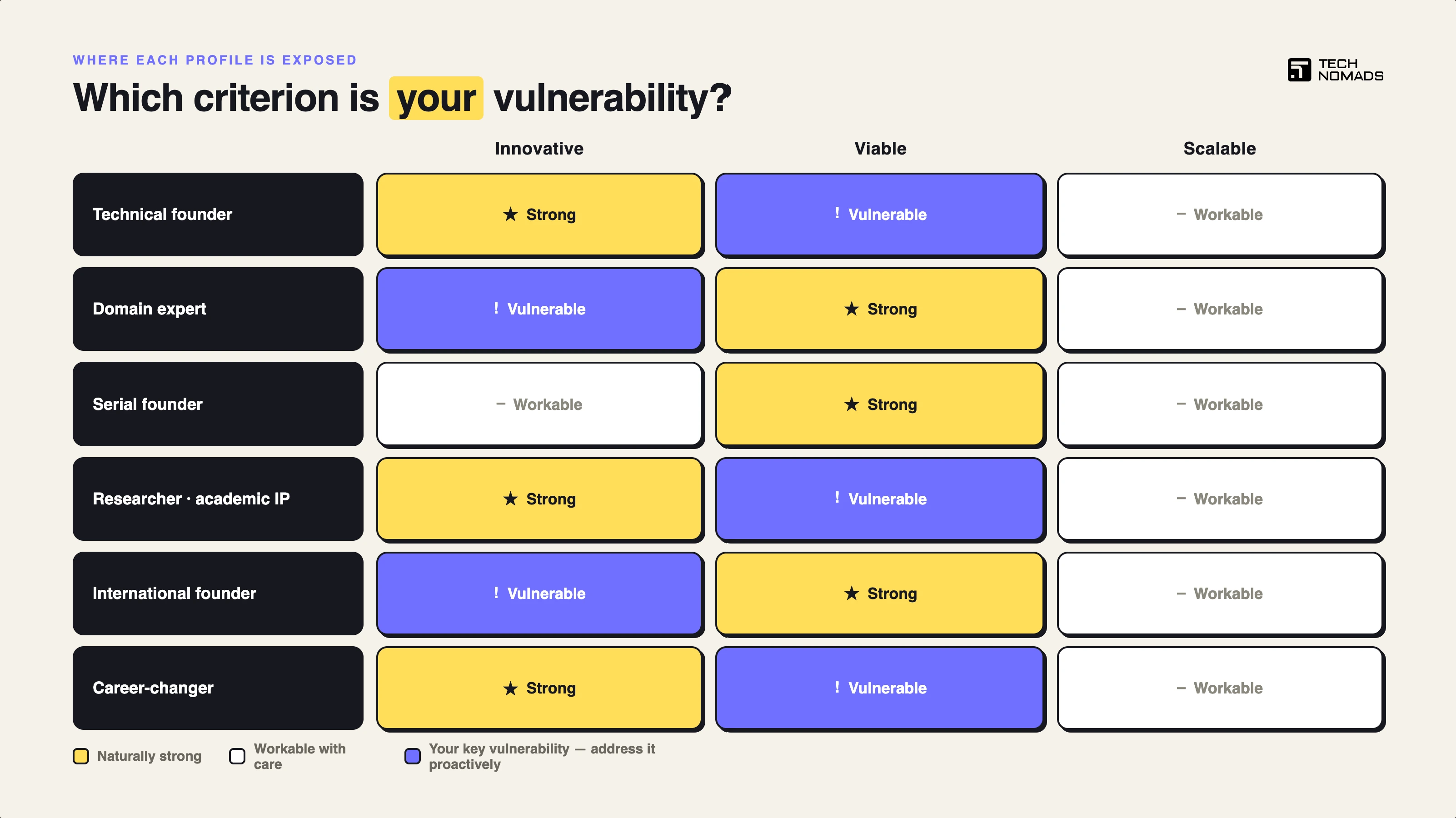
For a technical founder building a deep-tech product, the innovative criterion is typically easy to establish, but the viable criterion requires evidence that the founder can operate as a business builder, not just an engineer. For a domain expert turned entrepreneur, the viable criterion is strong, but the innovative criterion requires careful articulation of what is genuinely new versus what is simply a better execution of an existing model. For a career-changer, both the viable and the innovative criteria require extra evidential support to compensate for the absence of a directly relevant track record.
Understanding which criterion is the vulnerability for your specific profile and addressing it proactively in the application is one of the most valuable things a founder can do before submitting.
Why the Same Idea Can Succeed or Fail Depending on Who Is Pitching It
Two founders can propose identical business concepts and receive different outcomes. The founder, whose professional background directly connects to the proposed business, who has spent years in the industry they are disrupting, who understands the customer's problem from personal experience, and who has the technical skills to build the product, satisfies the viable criterion more easily than a founder whose background is unrelated.
This is not unfair. It reflects the endorsing body's legitimate assessment of execution risk. A plan is only as credible as the person proposing it.
What the Endorsing Body Cannot Assess From the Application Alone
The endorsing body cannot assess your character, your resilience, your network, or your ability to adapt. It can only assess what is in the submission. This means that founders who are genuinely exceptional but who have not documented their standing — who have informal networks, unwritten domain knowledge, and unrecorded achievements — will be assessed as weaker than they are. The application must make explicit what the founder cannot assume is obvious.
Profile 1: The Technical Founder
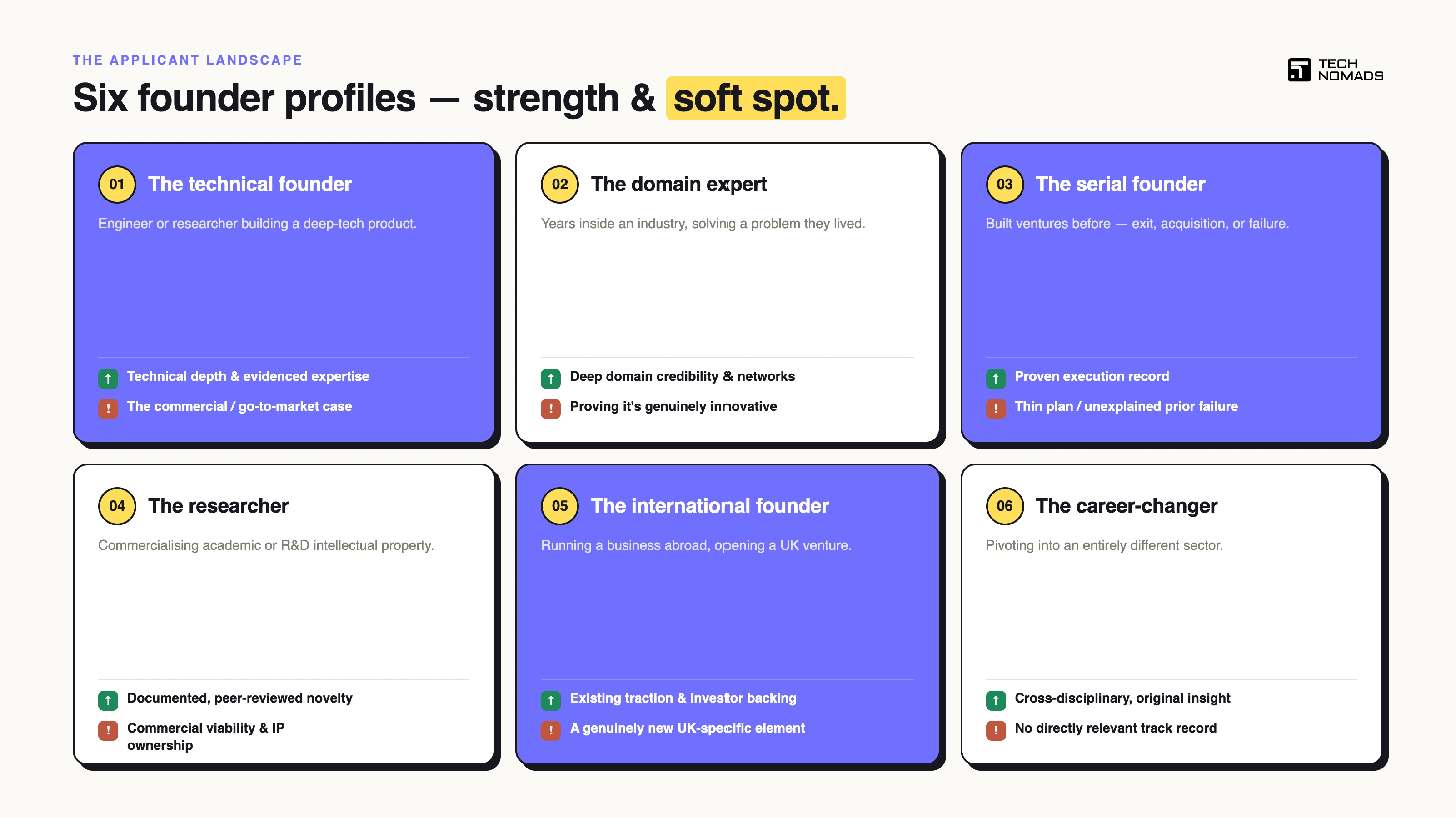
The technical founder is a software engineer, data scientist, AI researcher, or similar practitioner who has identified a problem in their domain and is building a technology product to address it. This is one of the most common innovator founder visa applicant profiles and one of the most naturally strong when the application is built correctly.
Strengths of this profile
Technical depth is the most compelling evidence for the innovative criterion. A technical founder can explain precisely what their product does differently from existing solutions, why existing approaches fail, and what their technical approach enables. This specificity, which non-technical founders sometimes struggle to produce, satisfies the endorsing body's need to understand what is genuinely new.
Technical founders also typically have a well-evidenced background. GitHub profiles, published work, open-source contributions, and conference speaking all serve as independent documentation of expertise that non-technical founders cannot easily replicate.
Weaknesses and how to address them
The technical founder's vulnerability is the viable criterion — specifically, the business-building dimension of viability. A product that is technically impressive but has no documented go-to-market strategy, no customer discovery evidence, and financial projections that appear to have been written in an afternoon will fail the viable criterion regardless of the technical quality of the idea.
Technical founders should invest as much time in the commercial sections of the business plan as in the technical sections. Customer discovery — at least five to ten documented conversations with potential customers in the UK market is one of the most effective investments a technical founder can make before applying. Letters of intent, however informal, carry significant weight.
Evidence that works best for this profile
Technical documentation of the product or prototype. GitHub repository or equivalent demonstrating development progress. Customer discovery documentation — interview notes, survey results, waitlist data. Letters of intent from potential UK customers or partners. Evidence of the founder's technical standing — conference speaking, open-source adoption, published writing that establishes the credibility of their technical claims.
The domain expert is a professional who has spent years in a specific industry — fintech, healthtech, logistics, education, legal services and is founding a business that addresses a problem they have encountered directly through that career. This profile has natural advantages in the viable criterion that technical founders must work harder to establish.
Strengths of this profile
Deep domain knowledge is compelling evidence for the viable criterion. A founder who has spent a decade in financial services compliance and is building a regulatory technology product for that sector can demonstrate, with specificity, that they understand the customer's problem, the regulatory environment, and the competitive landscape in a way that an outsider cannot. The endorsing body is assessing whether the founder can execute the plan, and a founder with direct domain experience has a credible answer.
Domain experts also typically have professional networks in the relevant sector, which provide access to potential customers, potential advisers, and potential reference sources for recommendation letters.
Weaknesses and how to address them
The domain expert's vulnerability is the innovative criterion. Many domain experts propose businesses that are essentially better versions of existing solutions — executed more efficiently, delivered more cheaply, or targeted at an underserved segment — without a fundamental differentiation that satisfies the endorsing body's innovative standard.
The innovation does not need to be technological. A new distribution model, a new customer segment previously considered unserved, a new combination of services that creates a genuinely different value proposition — all of these can satisfy the innovative criterion. But the differentiation must be articulated specifically, not assumed. "We do it better" is not a satisfying answer to the innovative criterion. "We do it differently, in this specific way, which existing solutions cannot replicate because of this specific constraint"
Evidence that works best for this profile
Professional CV demonstrating depth and progression in the relevant sector. Letters from independent industry figures — former colleagues at other organisations, industry analysts, potential customers who can attest to the market problem and the credibility of the founder's approach. Market research that demonstrates the founder's understanding of the UK opportunity. Evidence that the proposed solution is genuinely differentiated — competitive analysis, patent searches, or technical documentation of the differentiating mechanism.
Profile 3: The Serial Founder
The serial founder has previously built one or more companies, whether those ventures succeeded, were acquired, or failed and is bringing a new concept to the UK market. This profile has the strongest natural evidence for the viable criterion of any founder type, but it requires careful handling of prior history.
Strengths of this profile
Prior founding experience is among the most compelling evidence available for the viability criterion. A founder who has previously built a company, hired a team, raised funding, shipped a product, and managed commercial relationships has demonstrated the specific capabilities that the endorsing body is trying to assess. The viable criterion is easier to satisfy when the founder can point to a prior venture and say: I have done this before.
Investor relationships from prior ventures often provide access to credible, independent recommenders who can speak to the founder's capability — general partners at recognised funds, experienced angel investors, or board members from previous companies.
Weaknesses and how to address them
The serial founder's vulnerability depends on the outcome of prior ventures. A successful exit is an asset, but it does not carry the application on its own — the endorsing body assesses the current application on its merits. A prior failure, if recent or unexplained, must be addressed directly. The most effective approach is factual and forward-looking: what happened, what was learned, and specifically how the lessons from the previous venture inform the current one.
The other vulnerability for serial founders is underinvestment in the current application. Experienced founders sometimes treat the endorsement application as a formality, assuming that their track record will carry the submission without a detailed business plan. It will not. The endorsing body assesses the current concept on its own merits — a thin business plan from an experienced founder is still a thin business plan.
Evidence that works best for this profile
Companies House filings, cap table summaries, or investment documentation from previous ventures. Press coverage of previous companies that specifically addresses the founder's role and contribution. Reference letters from investors, board members, or co-founders from previous ventures. Evidence that the current concept is genuinely new — not simply a restart of the previous venture in a different market.
The researcher founder is an academic or industry researcher who has developed intellectual property through a university research programme, an industry R&D role, or independent research, and is proposing to commercialise it through a UK-based company. This profile has natural evidence for the innovative criterion but faces specific challenges around IP ownership and commercial viability.
Strengths of this profile
Academic research, almost by definition, produces novel outputs. A researcher who is commercialising their own published, peer-reviewed work has compelling evidence for the innovative criterion — the originality of the underlying research is documented, independently reviewed, and verifiable. Citation data, publication records, and academic standing all serve as credible third-party validation of the novelty and significance of the underlying technology or methodology.
Weaknesses and how to address them
The researcher's primary vulnerability is the viable criterion — specifically, the commercial dimension. Academic excellence does not automatically translate into business credibility. A business plan that describes the research in detail but treats the commercialisation as self-evidently straightforward will fail the viability criterion.
The second vulnerability is IP ownership. Research conducted at a university is typically owned by the university, not the researcher. Before applying, the researcher must have a clear, documented arrangement with the originating institution — a licence agreement, a technology transfer agreement, or a spin-out arrangement — that establishes their right to commercialise the IP. An application that glosses over this issue will raise immediate concerns for the endorsing body.
Evidence that works best for this profile
Published research with citation data establishes standing in the field. Documentation of the IP ownership or licensing arrangement from the originating institution. Letters from industry figures who can speak to the commercial relevance of the research — potential customers, technology transfer officers, or industry partners who have expressed interest. Evidence of commercial engagement — pilot agreements, industry partnerships, or Innovate UK funding — that demonstrates the technology's commercial relevance beyond the academic context
The international founder is already operating a business in another country — the US, Israel, India, Germany, or elsewhere — and is proposing to establish a UK-based operation as a new, distinct venture. This profile is eligible for the Innovator Founder Visa, provided the UK element is genuinely new and not simply a replication of the existing business in a new geography.
Strengths of this profile
Existing traction in another market is compelling evidence for the viability criterion. A founder whose company has already demonstrated product-market fit, raised investment from recognised investors, or generated meaningful revenue has evidence of commercial credibility that early-stage founders cannot match.
Existing investor relationships — particularly from ecosystems with strong UK connections, such as US venture capital with UK portfolios — can provide access to credible recommenders. Accelerator participation and institutional investor backing from recognised programmes (Y Combinator, Seedcamp, Techstars) are independently verifiable and carry weight.
Weaknesses and how to address them
The international founder's primary vulnerability is the innovative criterion as applied to the UK element. The endorsing body is not endorsing the existing business — it is endorsing the UK venture. The application must clearly explain what is new, innovative, and specifically UK-oriented about the proposed UK operation. A plan that simply describes the existing business and proposes to open a UK office will fail the innovative criterion. A plan that proposes a new product line for the UK market, a new partnership model specific to the UK ecosystem, or a new customer segment only addressable from a UK base has a clearer path to the innovative criterion.
Evidence that works best for this profile
Investment documentation from recognised investors in the existing venture. Press coverage of the existing business establishes its credibility and traction. Evidence of UK market engagement — customer discovery in the UK market, conversations with UK partners, or UK-specific market research. A clear articulation in the business plan of what is new about the UK venture relative to the existing operation.
The career-changer is a professional who is pivoting from one industry or discipline to found a business in an entirely different sector. This is the most challenging profile on the Innovator Founder Visa route, and the one that requires the most careful evidential construction.
Strengths of this profile
Career-changers sometimes bring cross-disciplinary insight that produces genuinely innovative ideas — the fintech founder who comes from insurance, the healthtech founder who comes from consumer behaviour research, the edtech founder who comes from professional services. Where the cross-disciplinary background is the source of the innovation, it should be framed as a strength rather than a liability.
Weaknesses and how to address them
The viable criterion is the central challenge. The endorsing body will ask: How does your background equip you to execute this specific plan? If the answer requires a significant leap of faith — if there is no direct connection between the founder's prior career and the proposed business — the viability assessment will be sceptical.
The most effective response is to document the domain acquisition process explicitly. Customer discovery — documented conversations with practitioners in the target sector — demonstrates that the founder has engaged with the problem from the inside, not just observed it from the outside. Advisers with direct sector experience compensate for the founder's absence of that experience. A co-founder with the domain expertise that the founder lacks addresses the gap structurally.
Evidence that works best for this profile
Primary research documentation — notes from customer interviews with named, contactable individuals in the target sector. Evidence of the domain acquisition process includes courses completed, industry events attended, sector publications read and cited in the business plan. Adviser and mentor letters from credible sector figures who can speak to the founder's grasp of the market. A co-founder profile that directly addresses the domain expertise gap.
Market Validation as the Great Equaliser
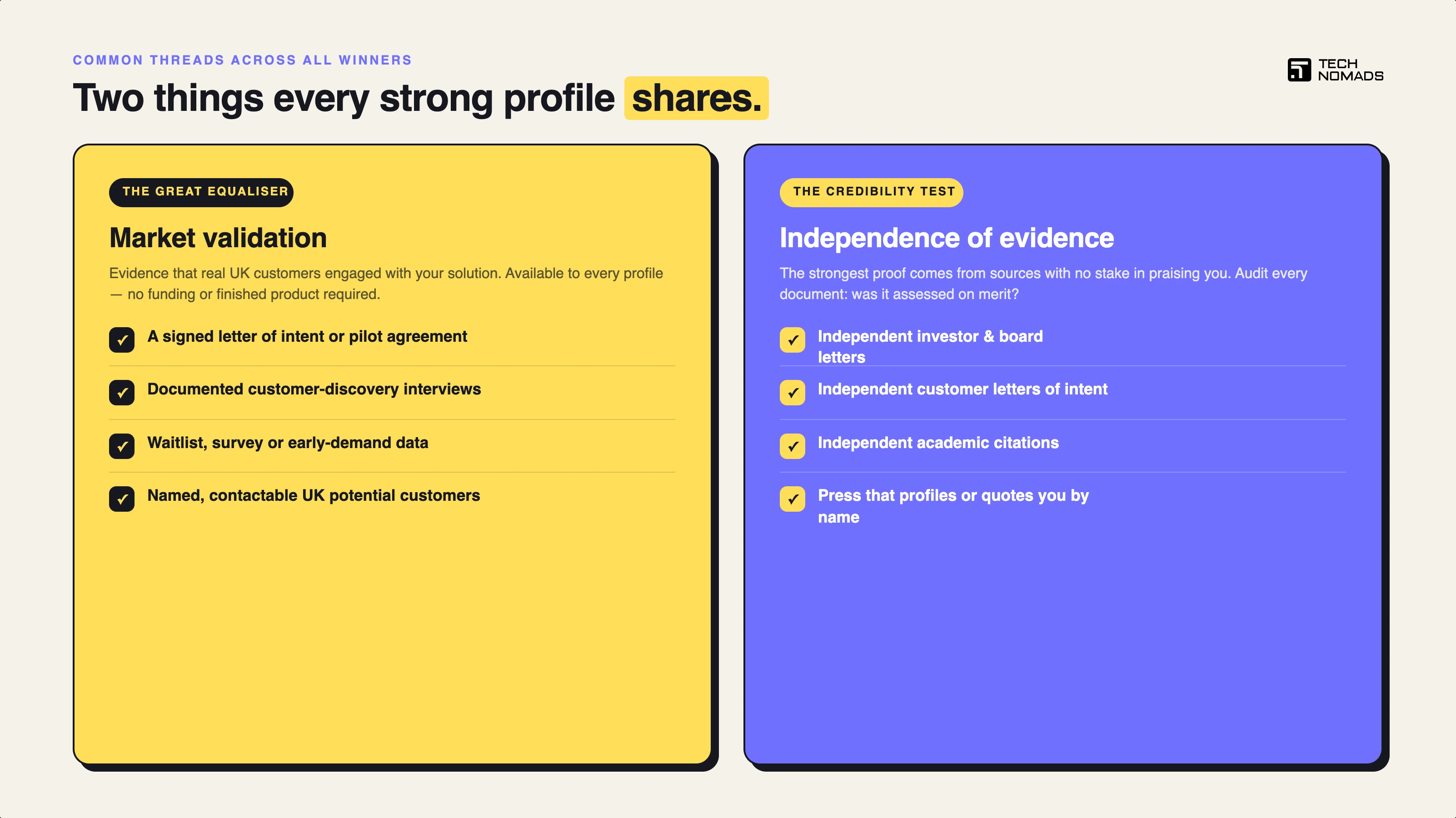
Across all six profile types, the single factor that most consistently strengthens an application is market validation — evidence that real potential customers in the UK market have engaged with the proposed solution and expressed genuine interest. A signed letter of intent, a pilot agreement, or documented primary research with specific potential customers does more to address the viable criterion than almost any other single piece of evidence.
Market validation is available to every founder, regardless of profile type. It does not require funding, a completed product, or an established track record. It requires the founder to speak to potential customers — directly, specifically, and with a genuine question and to document what they learn.
Independence of Evidence Across All Profiles
Every successful profile type shares one characteristic: the most compelling evidence comes from sources that have no commercial relationship with the founder and no obligation to speak positively about the venture. Independent investor letters, independent customer letters of intent, independent academic citations, independent press coverage — these carry more weight than any employer letter, family connection, or self-authored document.
Before submitting, every founder should audit their evidence package for independence. For every document included, ask: Does this come from a source that assessed my work on its merits, without any stake in saying something positive? If not, the evidence is weaker than it appears.
How Tech Nomads Positions Each Profile Type
Tech Nomads works with founders across all six profile types to identify the specific criteria vulnerabilities for their background and build the application around them. For technical founders, that typically means strengthening the commercial sections of the business plan. For career-changers, it means building a documented domain acquisition narrative. For serial founders, it means ensuring the current application is as detailed as it would be for a first-time founder.
The profile type determines the application strategy. The application strategy determines the outcome.
The lifestyle business founder: A business designed to provide the founder with a comfortable income, rather than to grow significantly, will fail the scalability criterion. The Innovator Founder Visa is not a self-employment visa. The business must have genuine growth potential.
The founder has no UK connection: A founder who has not engaged with the UK market has not spoken to UK customers, has not researched the UK competitive landscape, has not considered the UK regulatory environment, and will struggle to convince the endorsing body that the business will succeed in the UK specifically.
The founder, whose plan was clearly written for the visa, Endorsing bodies assess many applications. A business plan that reads as a document written to satisfy visa criteria — rather than a genuine commercial plan that the founder intends to execute — is identifiable and will not succeed.
The founder who is not actually ready to found: The Innovator Founder Visa requires the holder to actively work on the endorsed business in the UK. A founder who is still in full-time employment and has no realistic plan to transition to the venture full-time, or who has not thought through the operational realities of building a business in the UK, is applying before they are ready.
Tech Nomads is a global mobility platform that provides services for international relocation. Established in 2018, Tech Nomads has a track record of successfully relocating talents and teams. Our expertise in adapting to regulatory changes ensures our clients’ satisfaction and success.
Tech Nomads Club
Tech Nomads Club is a curated global community for highly skilled professionals.
We host free, application-based events, including expert panel talks, start-up pitch days, members-only networking, informal meetups, and fireside conversations with industry leaders.
Membership is free but selective — open to those building across borders and seeking meaningful growth through connection, knowledge, and community.
We also produce a regular podcast that shares real stories, insights, and voices from inside the Club.
Book a Consultation
Ready to find out whether the UK Global Talent Visa (Arts & Culture) is the right route for your profile?
To explore your UK relocation options, you may:
Subscribe to our social media platforms to stay up-to-date on global mobility news and opportunities:
Useful Resources:





Information made available on this website in any form is for information purposes only. It is not, and should not be taken as advice. You should not rely on, or take or fail to take any action based upon this information.
© Copyright 2024, All Rights Reserved

.png)
.png)
.png)

.avif)


.png)