.png)
Seek more insights? Subscribe to our Monthly Newsletter
The UK Global Talent Visa (Arts & Culture) is the most prestigious and flexible immigration route available to creative professionals seeking to live and work in the United Kingdom. It is not a work permit tied to a theatre company, gallery, or broadcaster. It is not dependent on a job offer or a salary threshold. It is a visa granted based on your standing as a creative professional — your recognition in the arts and culture sector, and it gives you the freedom to work however and wherever you choose in the UK from the moment it is granted.
For artists, performers, directors, curators, cultural leaders, and creative researchers, this is the route that treats your professional achievement as sufficient grounds for UK residency in its own right. This guide covers everything you need to know about the global talent visa arts and culture route in 2026 — what it is, who qualifies, how to apply, what it costs, and how it leads to permanent residency. All information is drawn from official Home Office guidance and Arts Council England's published criteria.
The Global Talent Visa (Arts & Culture) is a UK immigration route for individuals who are recognised leaders or emerging leaders in the arts and culture sector. It is assessed by Arts Council England, the Home Office's approved endorsing body for this route, which evaluates applications against published mandatory and optional criteria specific to the creative and cultural industries.
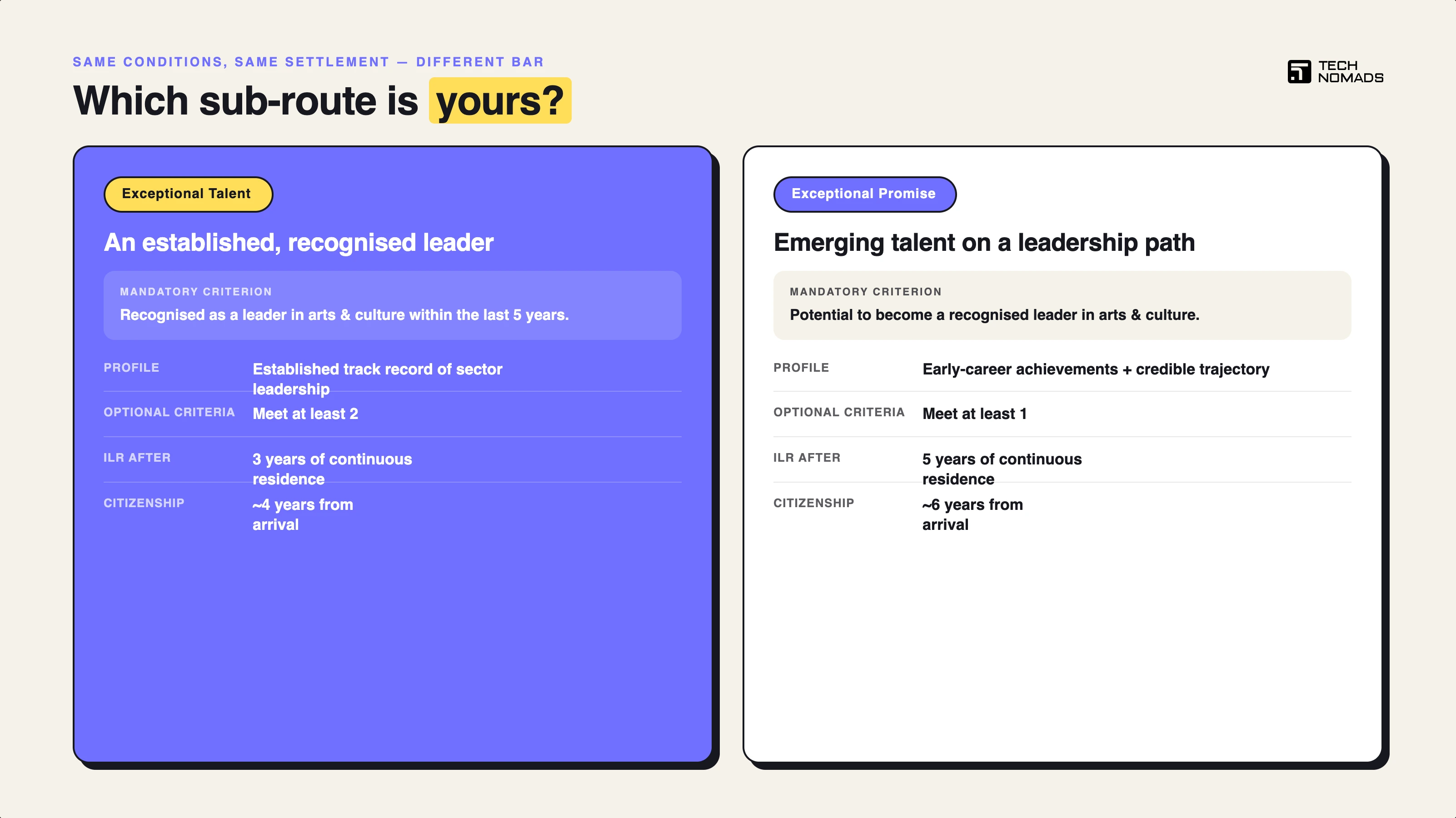
The visa operates through two sub-routes. Exceptional Talent is for those with an established track record of recognised leadership in the arts and culture sector. Exceptional Promise is for emerging talent with high potential to become a recognised leader. Both sub-routes carry identical visa conditions and lead to the same settlement pathway; the distinction lies in the evidential standard required.
Once granted, the visa is entirely employer-independent. Holders may work for any organisation, take on multiple engagements simultaneously, perform or exhibit freelance, hold artistic directorships, or pursue any combination of creative and commercial activity without restriction or notification to the Home Office.
(Source: gov.uk/global-talent; gov.uk/global-talent/apply-arts-and-culture; artscouncil.org.uk/global-talent-visa)
Eligibility at a Glance
Mandatory Eligibility Criteria
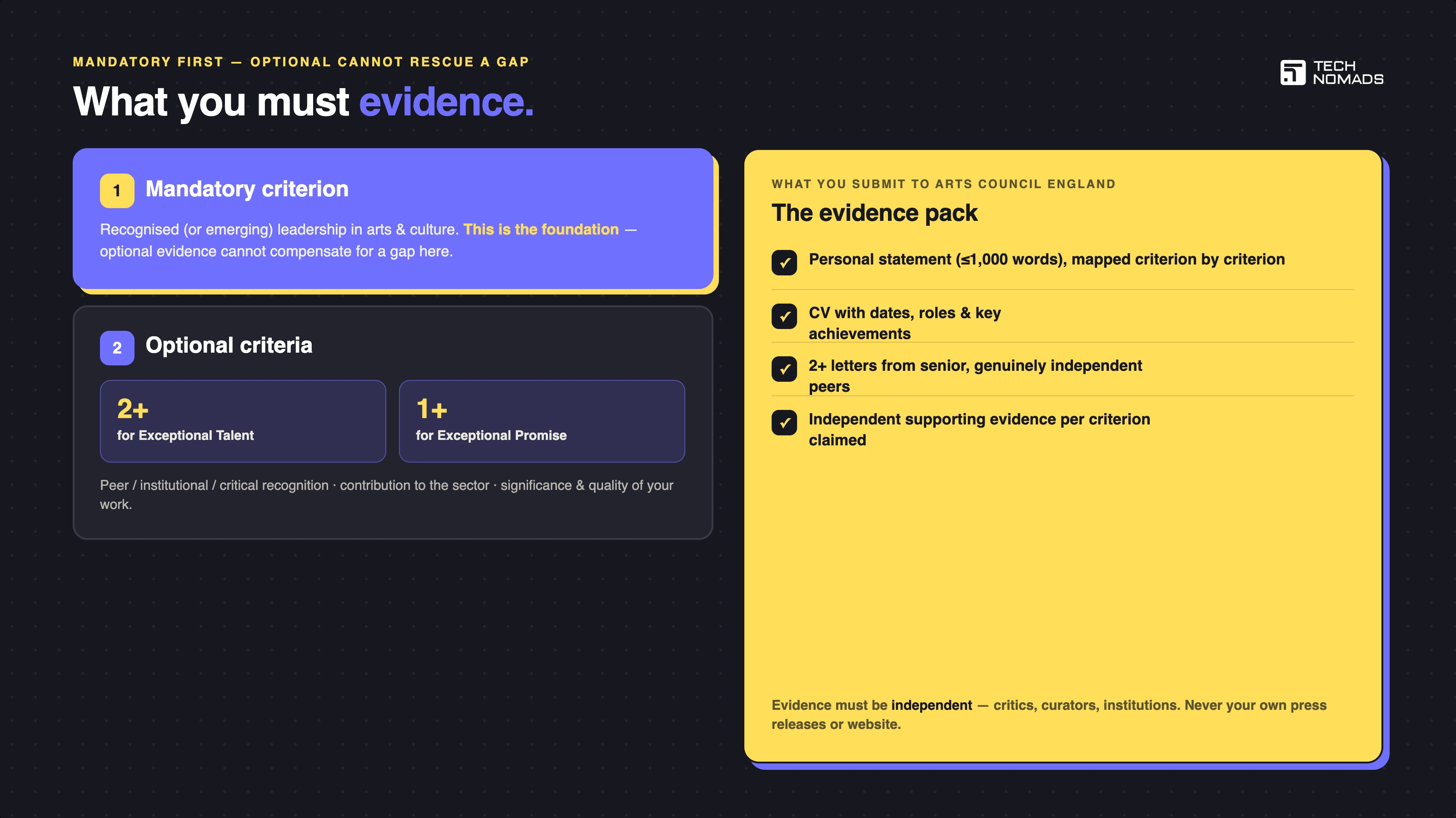
All applications for the Global Talent Visa (Arts & Culture) must satisfy the mandatory criterion for the chosen sub-route. This is the foundation of the application — optional criteria evidence cannot compensate for a failure to meet the mandatory criterion.
Exceptional Talent — mandatory criterion: You must demonstrate that you have been recognised as a leader in the arts and culture sector in the last five years. Recognition must be external and independently verifiable, not simply seniority within one organisation, but acknowledgement by the wider sector through critical coverage, peer recognition, institutional association, awards, or other markers of standing that extend beyond your immediate employer or collaborators.
Exceptional Promise — mandatory criterion: You must demonstrate that you have the potential to become a recognised leader in the arts and culture sector. This requires evidence of emerging talent — early-career achievements, a credible trajectory towards leadership, and a personal statement that makes a convincing, specific case for your future standing in the sector.
Beyond the mandatory criterion, applicants must satisfy at least two optional criteria for Exceptional Talent, or at least one optional criterion for Exceptional Promise. Arts Council England's published optional criteria for the arts and culture route include recognition by peers, institutions, or critics; contribution to the development of arts and culture in the UK or internationally; and evidence of the significance and quality of your creative work.
Document and Evidence Requirements
The endorsement application is submitted directly to Arts Council England and must include the following.
A personal statement of up to 1,000 words structured around the mandatory criterion and each optional criterion claimed. This is the most important document in the application. It must map your specific achievements to the specific criteria.
A CV covering your professional history with dates, roles, and key achievements.
At least two recommendation letters from senior, genuinely independent figures in the arts and culture sector who can speak to your standing and address the endorsement criteria directly. Letters from current employers, close collaborators, or family members are not appropriate. The recommender's own standing in the sector is part of the evidence.
Supporting evidence for every criterion claimed — exhibition catalogues, performance programmes, critical reviews, award documentation, press coverage, published works, festival programmes, broadcast credits, acquisition records, or equivalent documentation specific to your discipline.
Once endorsed, the visa application is submitted to the Home Office via the UKVI online portal, with biometric enrolment at a UKVCAS service point, payment of the visa fee and IHS.
Common Refusal Reasons
Endorsement refusal is the primary failure point on this route. The most consistent grounds for refusal based on published Arts Council England and Home Office guidance are as follows.
Failure to meet the mandatory criterion is the most common single reason. Strong evidence for optional criteria cannot compensate for a mandatory criterion gap. Arts professionals sometimes invest heavily in documenting optional achievements while leaving the mandatory criterion, recognised leadership or credible emerging leadership — inadequately evidenced.
Evidence that is self-generated or promotional rather than independently produced. Press releases, artist statements, and personal websites do not constitute independent evidence of recognition. All evidence of standing must come from sources with editorial independence: critics, curators, institutions, publications, not from the applicant or their own organisation.
Recommendation letters that are too generic or come from insufficiently independent sources. A letter that praises the applicant's talent without addressing the specific endorsement criteria, or that comes from a current employer rather than a genuinely independent senior peer, adds limited evidential value.
Applying under Exceptional Talent when the profile more accurately reflects Exceptional Promise or vice versa. Choosing the wrong sub-route is a structural error that undermines the application at the mandatory criterion stage.
The Global Talent Visa (Arts & Culture) follows the same two-stage structure as all Global Talent routes.
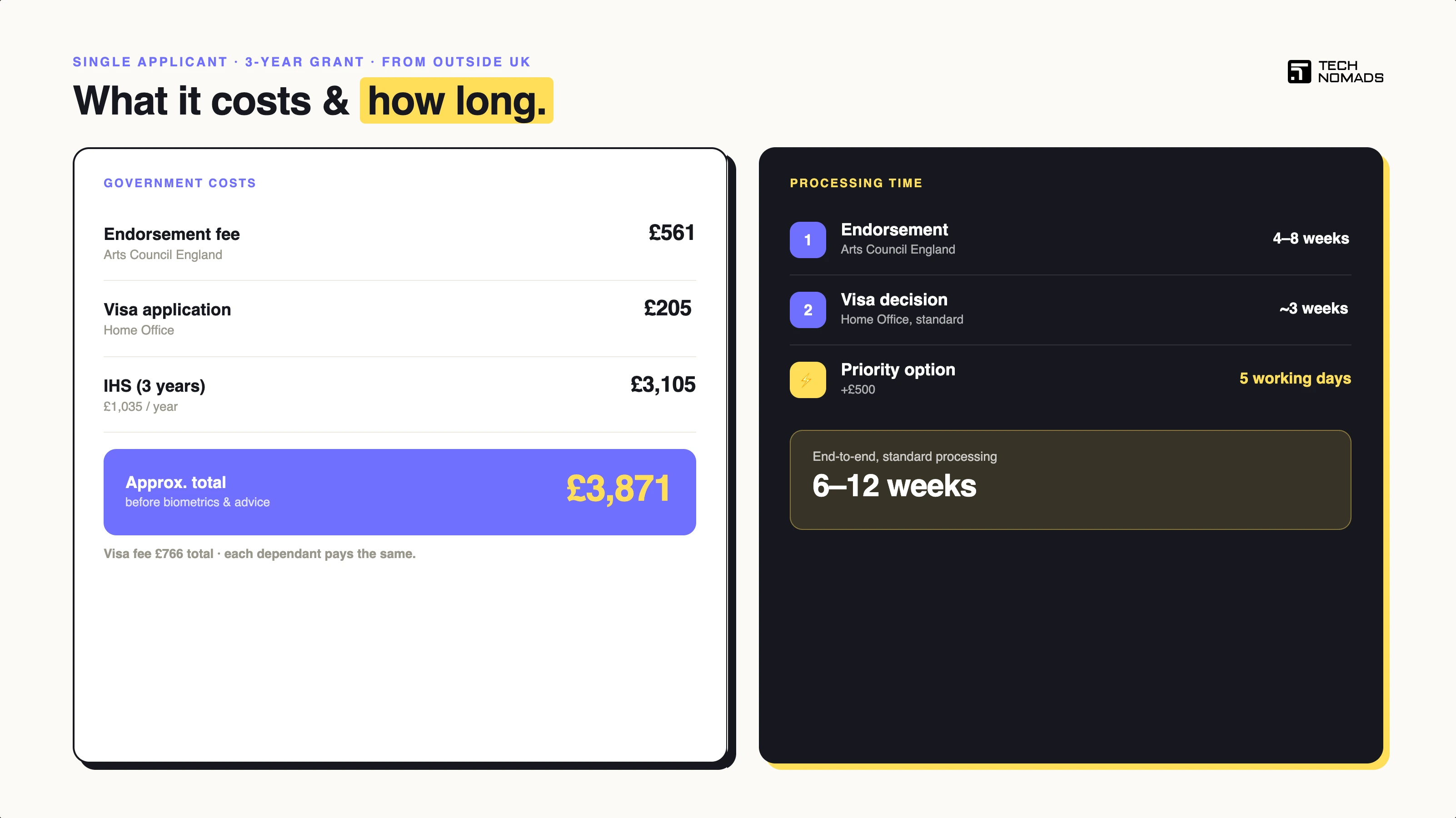
Stage 1 — Arts Council England endorsement: The application is submitted to Arts Council England with the personal statement, CV, recommendation letters, and supporting evidence. Arts Council England assesses the application and issues an endorsement or a refusal with written reasons. Processing typically takes four to eight weeks.
Stage 2 — Home Office visa application: Following endorsement, the visa application is submitted online via the UKVI portal. The applicant attends a biometric enrolment appointment at a UKVCAS service point. The Home Office targets three weeks for standard processing, with priority service available at an additional cost of £500, targeting five working days. Once approved, leave is granted, and the eVisa is issued.
Applicants may apply from outside the UK or, if already in the UK on most other visa categories, switch to the Global Talent Visa without leaving the country. The switching process follows the same two-stage structure and incurs the same fees.
Cost & Processing Time at a Glance
The total visa fee for the Global Talent Visa (Arts & Culture) is £766 per person, split into two payments: £561 paid at the endorsement stage to Arts Council England and £205 paid when the Home Office visa application is submitted. Dependants — a partner and children under 18 — each pay the same £766.
The Immigration Health Surcharge is payable at £1,035 per year of leave requested. For a three-year grant, this is £3,105 per person; for a five-year grant, £5,175 per person. The IHS is paid in full upfront at the visa application stage and covers full NHS access for the duration of leave.
Priority processing at Stage 2 costs an additional £500 and targets a five working day decision. Standard processing targets three weeks.
Estimated total government costs — single applicant, three-year grant, applying from outside UK: £561 (endorsement) + £205 (visa) + £3,105 (IHS, 3 years) = approximately £3,871, before biometric appointment fees or professional support costs.
End-to-end, from submitting the endorsement application to receiving the visa, most applicants should expect six to twelve weeks under standard processing.
The Global Talent Visa (Arts & Culture) leads directly to Indefinite Leave to Remain — the UK's permanent residency status without requiring a change of visa category or a new endorsement.
Exceptional Talent holders qualify for ILR after three years of continuous residence. Exceptional Promise holders qualify after five years. During the qualifying period, the holder must not have been absent from the UK for more than 180 days in any rolling 12-month period.
The ILR application is submitted on Form Set(O) via the UKVI portal. The current fee is £2,885 per applicant. The Life in the UK Test must be passed before applying. There is no English language requirement on this route at any stage, including ILR.
Following ILR, British citizenship is available after a further twelve months, subject to standard naturalisation requirements. The UK permits dual nationality — British citizenship does not require renunciation of existing citizenship.
For Exceptional Talent holders, the Global Talent Visa therefore represents one of the fastest available pathways to British citizenship for non-EEA nationals — four years from first arrival to citizenship eligibility, assuming continuous compliant residence throughout.
The Arts Council England endorsement is a subjective expert assessment, and the quality of how an application is built and presented is as important as the underlying strength of the applicant's creative career. Many arts professionals who are genuinely among the best in their field are refused endorsement because the application does not translate their achievements into the specific language and structure that the endorsing body assesses.
Working with Tech Nomads means receiving a specific, honest assessment of your profile before any endorsement fee is paid. For applicants who are ready to apply, Tech Nomads provides end-to-end support from personal statement drafting and evidence structuring to recommendation letter strategy and submission review.
Tech Nomads is a global mobility platform that provides services for international relocation. Established in 2018, Tech Nomads has a track record of successfully relocating talents and teams. Our expertise in adapting to regulatory changes ensures our clients’ satisfaction and success.
Tech Nomads Club
Tech Nomads Club is a curated global community for highly skilled professionals.
We host free, application-based events, including expert panel talks, start-up pitch days, members-only networking, informal meetups, and fireside conversations with industry leaders.
Membership is free but selective — open to those building across borders and seeking meaningful growth through connection, knowledge, and community.
We also produce a regular podcast that shares real stories, insights, and voices from inside the Club.
Book a Consultation
Ready to find out whether the UK Global Talent Visa (Arts & Culture) is the right route for your profile?
To explore your UK relocation options, you may:
Subscribe to our social media platforms to stay up-to-date on global mobility news and opportunities:
Useful Resources:





Information made available on this website in any form is for information purposes only. It is not, and should not be taken as advice. You should not rely on, or take or fail to take any action based upon this information.
© Copyright 2024, All Rights Reserved

.png)
.png)
.png)

.avif)


.png)